
The following OpenType features are included in this font:
WEIRDEST
BOLDNESS
Ethnological
Investigatory
Allegorical Poetry
Cardinal Griffolino
DISTRESSFUL BREATH
THE JOURNEY OF LIFE
The Unlimited Knowledge
Transitional State Of Mind
“Paradiso” is the third and final part of Dante’s Divine Comedy, following the “Inferno” and the “Purgatorio”. It is an allegory telling of Dante’s journey through Heaven, guided by Beatrice, who symbolises Christian grace or revelation. In the poem, Paradise is depicted as a series of concentric spheres surrounding the Earth, consisting of the Moon, Mercury, Venus, the Sun, Mars, Jupiter, Saturn, the Fixed Stars, the Primum Mobile and finally, the Empyrean.
Dante’s nine spheres of Heaven are the Moon, Mercury, Venus, the Sun, Mars, Jupiter, Saturn, the Fixed Stars, and the Primum Mobile. These are associated by Dante with the nine levels of the angelic hierarchy. Dante also relies on traditional associations, such as the one between Venus and romantic love. The first three spheres (which fall within the shadow of the Earth) are associated with deficient forms of Fortitude, Justice, and Temperance. The next four are associated with positive examples of Prudence, Fortitude, Justice, and Temperance; while Faith, Hope, and Love appear together in the eighth sphere.
The poem begins on the night of Maundy Thursday on March 24 (or April 7), 1300, shortly before the dawn of Good Friday. The narrator, Dante himself, is 35 years old, and thus “midway in the journey of our life” (Nel mezzo del cammin di nostra vita)—half of the biblical lifespan of 70 (Psalm 89:10 in the Vulgate; numbered as Psalm 90:10 in the King James Bible). The poet finds himself lost in a dark wood (selva oscura), astray from the “straight way” (diritta via, also translatable as “right way”) of salvation. He sets out to climb directly up a small mountain, but his way is blocked by three beasts he cannot evade: a lonza (usually rendered as “leopard” or “leopon”), a leone (lion), and a lupa (she-wolf). The three beasts, taken from Jeremiah 5:6, are thought to symbolize the three kinds of sin that bring the unrepentant soul into one of the three major divisions of Hell. According to John Ciardi, these are incontinence (the she-wolf); violence and bestiality (the lion); and fraud and malice (the leopard). It is now dawn of Good Friday, April 8, with the sun rising in Aries. The beasts drive him back despairing into the darkness of error, a “lower place” (basso loco) where the sun is silent (l sol tace). However, Dante is rescued by a figure who announces that he was born sub Iulio (i.e., in the time of Julius Caesar) and lived under Augustus: it is the shade of the Roman poet Virgil, author of the Aeneid, a Latin epic which also featured a journey through the underworld.
Informations
aalt
c2sc
calt
case
ccmp
cpsp
dlig
dnom
frac
hist
kern
liga
lnum
locl
numr
onum
ordn
pnum
smcp
ss01
ss02
ss03
ss04
ss05
ss06
ss07
ss08
subs
sups
tnum
zero
- river SS03Alternative r
- yoyo SS04Alternative y
- PLIURES DLIGDiscretionnary ligatures
- 2040 SS05Alternative zero
Glyphset
A
Uppercases
A
B
C
D
E
F
G
H
I
J
K
L
M
N
O
P
Q
R
S
T
U
V
W
X
Y
Z
Small Capitals
a
b
c
d
e
f
g
h
i
j
k
l
m
n
o
p
q
r
s
t
u
v
w
x
y
z
Lowercases
a
b
c
d
e
f
g
h
i
j
k
l
m
n
o
p
q
r
s
t
u
v
w
x
y
z
Accented Uppercases
À
Á
Â
Ã
Ä
Ā
Ă
Å
Ǻ
Ą
Æ
Ǽ
Ć
Ĉ
Č
Ċ
Ç
Ď
Đ
È
É
Ê
Ẽ
Ě
Ë
Ē
Ĕ
Ė
Ę
Ĝ
Ǧ
Ḡ
Ğ
Ġ
Ģ
Ĥ
Ħ
Ì
Í
Î
Ĩ
Ï
Ī
Ĭ
İ
Į
IJ
Ĵ
Ķ
Ĺ
Ľ
Ļ
Ł
Ŀ
Ń
Ň
Ñ
Ņ
Ò
Ó
Ô
Õ
Ö
Ō
Ŏ
Ő
Ǫ
Ø
Ǿ
Œ
Ŕ
Ř
Ŗ
ẞ
Ś
Ŝ
Š
Ş
Ș
Ť
Ț
Ţ
Ŧ
Ù
Ú
Û
Ũ
Ü
Ū
Ŭ
Ů
Ű
Ų
Ẁ
Ẃ
Ŵ
Ẅ
Ỳ
Ý
Ŷ
Ỹ
Ÿ
Ȳ
Ź
Ž
Ż
Ə
Ɲ
Ŋ
Ð
Þ
DŽ
Dž
LJ
Lj
NJ
Nj
Accented Small Capitals
à
á
â
ã
ä
ā
ă
å
ǻ
ą
æ
ǽ
ć
ĉ
č
ċ
ç
ď
đ
è
é
ê
ẽ
ě
ë
ē
ĕ
ė
ę
ĝ
ǧ
ḡ
ğ
ġ
ģ
ĥ
ħ
ì
í
î
ĩ
ï
ī
ĭ
i̇
į
ij
ĵ
ķ
ĺ
ľ
ļ
ł
ŀ
ń
ň
ñ
ņ
ò
ó
ô
õ
ö
ō
ŏ
ő
ǫ
ø
ǿ
œ
ŕ
ř
ŗ
ß
ś
ŝ
š
ş
ș
ť
ț
ţ
ŧ
ù
ú
û
ũ
ü
ū
ŭ
ů
ű
ų
ẁ
ẃ
ŵ
ẅ
ỳ
ý
ŷ
ỹ
ÿ
ȳ
ź
ž
ż
ə
ɲ
ŋ
ð
þ
dž
lj
nj
Accented Lowercases
à
á
â
ã
ä
ā
ă
å
ǻ
ą
æ
ǽ
ć
ĉ
č
ċ
ç
ď
đ
è
é
ê
ẽ
ě
ë
ē
ĕ
ė
ę
ĝ
ǧ
ḡ
ğ
ġ
ģ
ĥ
ħ
ì
í
î
ĩ
ï
ī
ĭ
i
į
ı
ij
ĵ
ȷ
ķ
ĺ
ľ
ļ
ł
ŀ
ń
ň
ñ
ʼn
ņ
ò
ó
ô
õ
ö
ō
ŏ
ő
ǫ
ø
ǿ
œ
ŕ
ř
ŗ
ś
ŝ
š
ş
ș
ß
ť
ț
ţ
ŧ
ù
ú
û
ũ
ü
ū
ŭ
ů
ű
ų
ẁ
ẃ
ŵ
ẅ
ỳ
ý
ŷ
ỹ
ÿ
ȳ
ź
ž
ż
ə
ɲ
ŋ
ð
þ
dž
lj
nj
Alternates (Italic only)
a
à
á
â
ã
ä
ā
ă
å
ǻ
ą
æ
ǽ
g
ĝ
ǧ
ḡ
ğ
ġ
ģ
Alternates
r
ŕ
ř
ŗ
y
ý
ŷ
ỹ
ÿ
ȳ
ỳ
Ligatures
WWW
www
Th
Wh
ſ
fb
ffb
ff
fh
ffh
fi
ffi
fì
ffì
fí
ffí
fî
ffî
fï
ffï
fį
ffį
fj
ffj
fk
ffk
fl
ffl
ft
fft
fy
ffy
fy
ffy
gg
gy
ggy
gy
ggy
tt
tv
tw
tty
tty
ty
ty
Discretionnary ligatures
AA
AB
AD
AF
AFF
AFFA
AFFI
AFFL
AFT
AH
AK
AKA
AKE
AKI
AKL
AKO
AKT
AKU
AKY
AL
ALA
ALE
ALI
ALL
ALO
ALU
ALY
AN
AND
ANE
AP
AR
ARA
ARE
ARI
ARL
ARS
AU
AV
AW
CA
CC
DE
DO
EB
ET
EV
EW
EY
FA
FF
FFI
FI
FFL
FJ
FL
FT
FTL
GG
GO
HT
HTF
HTI
IT
ITI
ITN
KA
KE
KI
KL
KO
KS
KT
KU
KV
KW
KY
LA
LE
LI
LL
LO
LS
LU
LY
MM
NB
ND
NE
NF
NH
NK
NL
NN
NP
NR
NRA
NRE
NRI
NRO
NRU
NRY
NT
OC
OG
OO
OQ
PP
QU
QUE
RA
RE
RI
RL
RO
RU
RR
RRA
RRE
RRI
RRO
RRU
RRY
RS
RY
SS
TE
TF
TH
THE
THR
THRA
THRE
THRI
THRO
THRU
TI
TK
TL
TN
TT
TV
TW
TY
UN
UP
UR
URA
URE
URI
URO
URS
URU
URY
VA
WA
XY
ZA
ZE
ZI
ZL
ZO
ZU
ZY
ZZ
cb
ch
ck
cl
ct
sb
sh
sk
sl
sp
st
Diacritics
́
̋
̂
̌
̆
̊
̇
̈
̃
̄
·
·
̀
́
̋
̂
̌
̆
̊
̇
̈
̃
̄
̒
̦
̧
̨
Lining figures and currencies
#
0
1
2
3
4
5
6
7
8
9
€
$
₿
¢
£
₺
ƒ
¥
₸
฿
₴
₽
₹
₪
₩
₫
Old style figures and currencies
#
0
1
2
3
4
5
6
7
8
9
€
$
₿
¢
£
₺
ƒ
¥
₸
฿
₴
₽
₹
₪
₩
₫
Tabular figures and currencies
#
0
1
2
3
4
5
6
7
8
9
€
$
₿
¢
£
₺
ƒ
¥
₸
฿
₴
₽
₹
₪
₩
₫
Tabular old style figures and currencies
#
0
1
2
3
4
5
6
7
8
9
€
$
₿
¢
£
₺
ƒ
¥
₸
฿
₴
₽
₹
₪
₩
₫
Slashed Zeros
0
Mathematical symbols
+
−
±
×
÷
=
≠
~
≈
^
¬
⌀
¤
<
>
≤
≥
∞
◊
Δ
Ω
∂
∫
√
∑
∏
π
μ
°
ℓ
℮
〈
〉
【
】
「
」
《
》
〔
〕
〖
〗
『
』
Case sensitive mathematical symbols
+
−
×
÷
=
≠
~
≈
¬
<
>
Superior figures
,
.
(
)
+
−
×
÷
=
0
1
2
3
4
5
6
7
8
9
Inferior figures
,
.
(
)
+
−
×
÷
=
0
1
2
3
4
5
6
7
8
9
Numerators
,
.
(
)
+
−
×
÷
=
0
1
2
3
4
5
6
7
8
9
Denominators
,
.
(
)
+
−
×
÷
=
0
1
2
3
4
5
6
7
8
9
Open circled figures
0
1
2
3
4
5
6
7
8
9
10
Close circled figures
0
1
2
3
4
5
6
7
8
9
10
Fractions
⁄
%
‰
¼
½
¾
⅛
⅜
⅝
⅞
Roman figures
Ⅰ
Ⅱ
Ⅲ
Ⅳ
Ⅴ
Ⅵ
Ⅶ
Ⅷ
Ⅸ
Ⅼ
Ⅽ
Ⅾ
Ⅿ
Standard punctuation
,
;
:
.
…
-
!
¡
?
¿
‽
⸮
@
‘
’
“
”
‚
„
‘
“
‹
›
«
»
&
/
\
|
¦
_
–
—
•
·
(
)
[
]
{
}
*
⁂
†
‡
§
¶
Case sensitive punctuation
-
–
—
·
‹
›
«
»
(
)
[
]
{
}
¡
¿
@
Abbreviations
℃
℉
℀
℁
℆
℅
©
℗
®
™
℠
ª
º
№
Geometrical symbols
■
□
◆
◇
●
○
◧
◨
⬒
⬓
◩
⬔
⬕
◪
⬖
⬗
⬘
⬙
◐
◑
◓
◒
◀
▶
▲
▼
◁
▷
△
▽
◂
▸
▴
▾
◃
▹
▵
▿
⏏
⏪
⏩
⏫
⏬
⏮
⏭
⏯
⏸
⏹
⏺
Miscellaneous symbols
✴
✳
✺
☀
☼
☽
☾
⚡
☁
⚙
♀
♂
⚲
⚫
⚪
◉
◎
🔍
🔎
🔒
🔓
≡
❌
⌘
♥
♡
⚑
⚐
★
☆
❤
♠
♣
♦
✓
✗
☐
☑
☒
❏
❍
◌
Arrows
←
↑
→
↓
↖
↗
↘
↙
↔
↕
➤
➣
➢
↰
↱
↲
↳
⬑
⬏
⬐
⬎
⭰
⭲
⭱
⭳
ꜜ
🔀
🔁
🔂
⮀
⮂
⮁
⮃
⮌
⮎
⮏
⮍
🔃
🔄
⟳
⟲
Languages
Abenaki, Afaan Oromo, Afar, Afrikaans, Albanian, Alsatian, Amis, Anuta, Aragonese, Aranese, Aromanian, Arrernte, Arvanitic, Asturian, Atayal, Aymara, Azerbaijani, Bashkir, Basque, Belarusian, Bemba, Bikol, Bislama, Bosnian, Breton, Cape Verdean Creole, Catalan, Cebuano, Chamorro, Chavacano, Chichewa, Chickasaw, Cimbrian, Cofán, Cornish, Corsican, Creek, Crimean Tatar, Croatian, Czech, Danish, Dawan, Delaware, Dholuo, Drehu, Dutch, English, Esperanto, Estonian, Faroese, Fijian, Filipino, Finnish, Folkspraak, French, Frisian, Friulian, Gagauz, Galician, Ganda, Genoese, German, Gikuyu, Gooniyandi, Greenlandic, Guadeloupean Creole, Gwich'in, Haitian Creole, Hän, Hawaiian, Hiligaynon, Hopi, Hotcąk, Hungarian, Icelandic, Ido, Igbo, Ilocano, Indonesian, Interglossa, Interlingua, Irish, Istro-Romanian, Italian, Jamaican, Javanese, Jèrriais, Kaingang, Kala Lagaw Ya, Kapampangan, Kaqchikel, Karakalpak, Karelian, Kashubian, Kikongo, Kinyarwanda, Kiribati, Kirundi, Klingon, Kurdish, Ladin, Latin, Latino sine Flexione, Latvian, Lithuanian, Lojban, Lombard, Low Saxon, Luxembourgish, Maasai, Makhuwa, Malay, Maltese, Manx, Māori, Marquesan, Megleno-Romanian, Meriam Mir, Mirandese, Mohawk, Moldovan, Montagnais, Montenegrin, Murrinh-Patha, Nagamese Creole, Nahuatl, Ndebele, Neapolitan, Ngiyambaa, Niuean, Noongar, Norwegian, Novial, Occidental, Occitan, Old Icelandic, Old Norse, Onĕipŏt, Oshiwambo, Ossetian, Palauan, Papiamento, Piedmontese, Polish, Portuguese, Potawatomi, Q'eqchi', Quechua, Rarotongan, Romanian, Romansh, Rotokas, Sami, Samoan, Sango, Saramaccan, Sardinian, Scottish Gaelic, Serbian, Seri, Seychellois Creole, Shawnee, Shona, Sicilian, Silesian, Slovak, Slovenian, Slovio, Somali, Sorbian, Sotho, Spanish, Sranan, Sundanese, Swahili, Swazi, Swedish, Tagalog, Tahitian, Tetum, Tok Pisin, Tokelauan, Tongan, Tshiluba, Tsonga, Tswana, Tumbuka, Turkish, Turkmen, Tuvaluan, Tzotzil, Uzbek, Venetian, Vepsian, Volapük, Võro, Wallisian, Walloon, Waray-Waray, Warlpiri, Wayuu, Welsh, Wik-Mungkan, Wiradjuri, Wolof, Xavante, Xhosa, Yapese, Yindjibarndi, Zapotec, Zarma, Zazaki, Zulu, Zuni
About
“We choose to believe that the granite is alive. If life is movement, then rock—with its atoms flying around like stars in cosmos—is alive.”
Yvon Chouinard
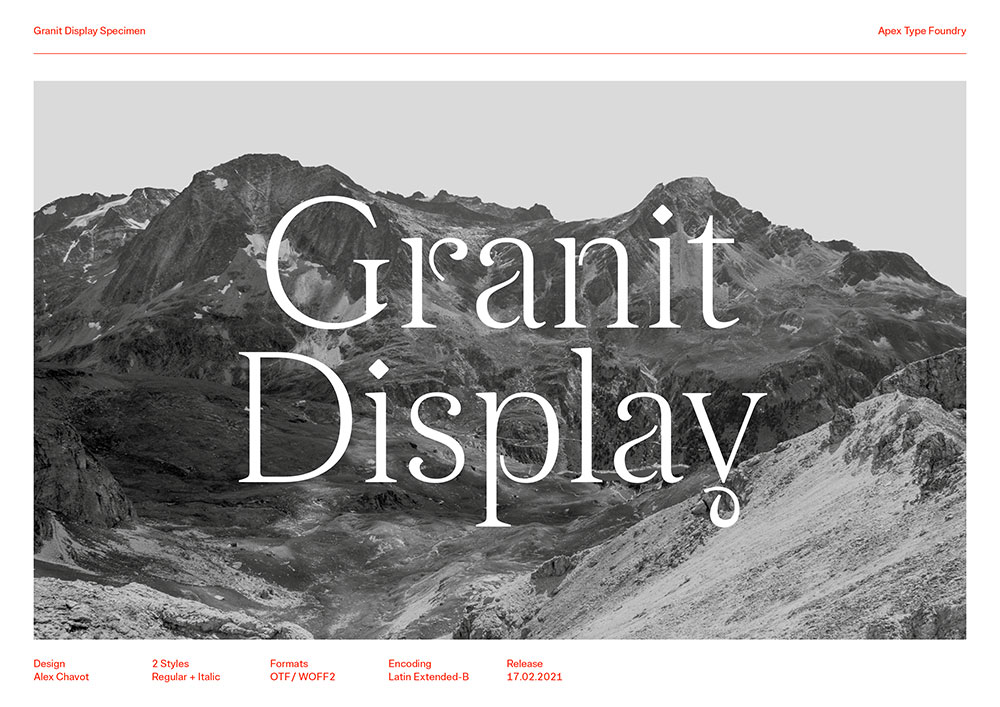
Gleaning vernacular letterforms from the realm of 19th and 20th century headstones (including from the notorious Père-Lachaise cemetery) as initial inspirations, Alex Chavot revisits these varied sources into a new display typeface with a modern sensibility. Discreet and elegant in its contrast, Granit is a sharp serif typeface that speaks with refinement and achieves the perfect balance between gravity and delicacy. The proportions of its capitals—loosely based on the monumental Roman models—give it the austere “gravitas” and graceful confidence of historical inscriptional letters while, on the other hand, its lowercases tend to be slightly more condensed, thus creating an unexpected contrast in text settings. Granit inherits its distinctive personality from a very specific stencil-like feature often found on letters such as “a”, “g”, “n”, “r”, “y”… While giving us a glimpse at the by-gone charm of traditional stone carving techniques, these subtleties empower Granit’s palette with a more eccentric and optimistic character that reinvigorate any composition. This fragile tension between stone-harshness and hand-finesse is even more palpable in Granit’s italic: with a slightly-more-condensed width, it oscillates between mechanical slant and calligraphic forms—additionally offering alternate characters for designers to play with. Granit definitively aims at top league whimsical titling players with its full set of 230+ ligatures to create dynamic, expressive headlines.
Download PDF
You may also like
 View all