
The following OpenType features are included in this font:
FURNITURE
GERONTIUS
Contrapuntal
Represented
Das Unaufhörliche
Belshazzar’s Feast
The Epic of Gilgamesh (1958)
Joseph Haydn’s “The Creation” (1798) and “The Seasons” (1801) have remained the most widely known oratorios from the period of classicism. While the first of these Handel inspired works draws from the religious theme of creation, the second is more secular, containing songs about industry, hunting and wine.
Britain continued to look to Germany for its composers of oratorio. The Birmingham Festival commissioned various oratorios including Felix Mendelssohn’s “Elijah” in 1846, later performed in German as “Elias”. German composer Georg Vierling is noted for modernizing the secular oratorio form. John Stainer’s “The Crucifixion” (1887) became the stereotypical battlehorse of massed amateur choral societies. Edward Elgar tried to revive the genre around the turn of century with the composition of “The Light of Life” (Lux Christi), “The Dream of Gerontius”, “The Apostles” and “The Kingdom”.
When Dudley Buck composed his oratorio ‘The Light of Asia’ in 1886, it became the first in the history of the genre to be based on the life of Buddha. Several late 20th and early 21st-century oratorios have since been based on Buddha’s life or have incorporated Buddhist texts. These include Somei Satoh’s 1987 ‘Stabat Mater’, Dinesh Subasinghe’s 2010 ‘Karuna Nadee’, and Jonathan Harvey’s 2011 ‘Weltethos’. The 21st century also saw a continuation of Christianity-based oratorios with John Adams’s ‘El Niño’ and ‘The Gospel According to the Other Mary’. Other religions represented include Ilaiyaraaja’s ‘Thiruvasakam’ (based on the texts of Hindu hymns to Shiva). Secular oratorios composed in the 21st century include Nathan Currier’s ‘Gaian Variations’ (based on the Gaia hypothesis), Richard Einhorn’s ‘The Origin’ (based on the writings of Charles Darwin), Jonathan Mills’ ‘Sandakan Threnody’ (based on the Sandakan Death Marches), Neil Hannon’s ‘To Our Fathers in Distress’, and David Lang’s ‘The Little Match Girl Passion’ (2008). ‘Because of My Name’ (2016) is based on the assassination of Father Jerzy Popiełuszko on 19 October 1984, including the song dedicated to him, ‘Błogosławiony ksiądz Jerzy Popiełuszko’, composed by Piotr Rubik. The oratorio ‘Laudato si’, composed in 2016 by Peter Reulein on a libretto by Helmut Schlegel, includes the full Latin text of the ‘Magnificat’, expanded by writings of Clare of Assisi, Francis of Assisi and Pope Francis. ‘Bruder Martin’ was composed by Thomas Gabriel, setting a text by Eugen Eckert about scenes from the life of Martin Luther, for the 500th anniversary of the Reformation in 2017. In 2017, Jörg Widmann’s oratorio ‘ARCHE’ premiered. A transfer of sacrality to secular contexts takes place.
Informations
aalt
calt
case
ccmp
cpsp
dlig
dnom
frac
hist
kern
liga
lnum
locl
numr
onum
ordn
pnum
sinf
ss01
ss02
ss03
ss04
ss05
ss06
ss07
ss08
ss09
subs
sups
titl
zero
- ELIJAH ss01Alternative J
- MARY ss02Alternative M
- QUOTE ss03Alternative Q
- REX ss04Alternative R
Glyphset
A
Uppercases
A
B
C
D
E
F
G
H
I
J
K
L
M
N
O
P
Q
R
S
T
U
V
W
X
Y
Z
Lowercases
a
b
c
d
e
f
g
h
i
j
k
l
m
n
o
p
q
r
s
t
u
v
w
x
y
z
Accented Uppercases
À
Á
Â
Ã
Ä
Ā
Ă
Å
Ǻ
Ą
Æ
Ǽ
Ć
Ĉ
Č
Ċ
Ç
Ď
Đ
È
É
Ê
Ẽ
Ě
Ë
Ē
Ĕ
Ė
Ę
Ĝ
Ǧ
Ḡ
Ğ
Ġ
Ģ
Ĥ
Ħ
Ì
Í
Î
Ĩ
Ï
Ī
Ĭ
İ
Į
IJ
Ĵ
Ķ
Ĺ
Ľ
Ļ
Ł
Ŀ
Ń
Ň
Ñ
Ņ
Ò
Ó
Ô
Õ
Ö
Ō
Ŏ
Ő
Ǫ
Ø
Ǿ
Œ
Ŕ
Ř
Ŗ
ẞ
Ś
Ŝ
Š
Ş
Ș
Ť
Ț
Ţ
Ŧ
Ù
Ú
Û
Ũ
Ü
Ū
Ŭ
Ů
Ű
Ų
Ẁ
Ẃ
Ŵ
Ẅ
Ỳ
Ý
Ŷ
Ỹ
Ÿ
Ȳ
Ź
Ž
Ż
Ə
Ɲ
Ŋ
Ð
Þ
DŽ
Dž
LJ
Lj
NJ
Nj
Accented Lowercases
à
á
â
ã
ä
ā
ă
å
ǻ
ą
æ
ǽ
ć
ĉ
č
ċ
ç
ď
đ
è
é
ê
ẽ
ě
ë
ē
ĕ
ė
ę
ĝ
ǧ
ḡ
ğ
ġ
ģ
ĥ
ħ
ì
í
î
ĩ
ï
ī
ĭ
i
į
ı
ij
ĵ
ȷ
ķ
ĺ
ľ
ļ
ł
ŀ
ń
ň
ñ
ʼn
ņ
ò
ó
ô
õ
ö
ō
ŏ
ő
ǫ
ø
ǿ
œ
ŕ
ř
ŗ
ś
ŝ
š
ş
ș
ß
ť
ț
ţ
ŧ
ù
ú
û
ũ
ü
ū
ŭ
ů
ű
ų
ẁ
ẃ
ŵ
ẅ
ỳ
ý
ŷ
ỹ
ÿ
ȳ
ź
ž
ż
ə
ɲ
ŋ
ð
þ
dž
lj
nj
Alternates
J
IJ
Ĵ
LJ
NJ
M
Q
R
Ŕ
Ř
Ŗ
Titling alternates
A
B
D
E
F
G
H
I
J
K
L
M
N
O
P
Q
R
S
T
U
V
W
X
Y
Ligatures
WWW
www
Th
Wh
ſ
fb
ffb
ff
fh
ffh
fi
ffi
fj
ffj
fk
ffk
fl
ffl
ft
fft
tt
Discretionnary ligatures
AA
EE
FF
GG
KK
LL
MM
MM
NN
OO
SS
TT
ZZ
cb
ch
ck
cl
ct
sb
sh
sk
sl
sp
st
Diacritics
́
̋
̂
̌
̆
̊
̇
̈
̃
̄
·
·
̀
́
̋
̂
̌
̆
̊
̇
̈
̃
̄
̒
̦
̧
̨
Lining figures and currencies
#
0
1
2
3
4
5
6
7
8
9
€
$
¢
£
ƒ
¥
Old style figures and currencies
#
0
1
2
3
4
5
6
7
8
9
€
$
¢
£
ƒ
¥
Slashed Zeros
0
Mathematical symbols
+
−
±
×
÷
=
≠
~
≈
^
¬
⌀
¤
<
>
≤
≥
°
〈
〉
【
】
「
」
《
》
〔
〕
〖
〗
『
』
Case sensitive mathematical symbols
+
−
×
÷
=
≠
~
≈
¬
<
>
Superior figures
,
.
(
)
+
−
×
÷
=
0
1
2
3
4
5
6
7
8
9
Inferior figures
,
.
(
)
+
−
×
÷
=
0
1
2
3
4
5
6
7
8
9
Numerators
,
.
(
)
+
−
×
÷
=
0
1
2
3
4
5
6
7
8
9
Denominators
,
.
(
)
+
−
×
÷
=
0
1
2
3
4
5
6
7
8
9
Open circled figures
0
1
2
3
4
5
6
7
8
9
10
Close circled figures
0
1
2
3
4
5
6
7
8
9
10
Fractions
⁄
%
‰
¼
½
¾
⅛
⅜
⅝
⅞
Standard punctuation
,
;
:
.
…
-
!
¡
?
¿
‽
⸮
@
‘
’
“
”
‚
„
‘
“
‹
›
«
»
&
/
\
|
¦
_
–
—
•
·
(
)
[
]
{
}
*
⁂
†
‡
§
¶
Case sensitive punctuation
-
–
—
·
‹
›
«
»
(
)
[
]
{
}
¡
¿
@
Abbreviations
©
℗
®
™
℠
ª
º
№
Geometrical symbols
■
□
◆
◇
●
○
◧
◨
⬒
⬓
◩
⬔
⬕
◪
⬖
⬗
⬘
⬙
◐
◑
◓
◒
◀
▶
▲
▼
◁
▷
△
▽
◂
▸
▴
▾
◃
▹
▵
▿
Miscellaneous symbols
⚫
⚪
◉
◎
✓
✗
☐
☑
☒
❏
❍
◌
Arrows
←
↑
→
↓
↖
↗
↘
↙
↔
↕
Languages
Acheron, Achinese, Acholi, Achuar-Shiwiar, Afar, Afrikaans, Aguaruna, Alekano, Aleut, Alonquin, Amahuaca, Amarakaeri, Amis, Anaang, Andaandi, Dongolawi, Anuta, Aragonese, Arbëreshë Albanian, Asháninka, Ashéninka Perené, Atayal, Balinese, Banjar, Bari, Basque, Batak Dairi, Batak Karo, Batak Mandailing, Batak Simalungun, Batak Toba, Bemba (Zambia), Bena (Tanzania), Bikol, Bislama, Borana-Arsi-Guji Oromo, Bosnian, Breton, Buginese, Candoshi-Shapra, Caquinte, Caribbean Hindustani, Cashibo-Cacataibo, Cashinahua, Catalan, Cebuano, Central Aymara, Central Kurdish, Chachi, Chamorro, Chavacano, Chiga, Chiltepec Chinantec, Chokwe, Chuukese, Cimbrian, Cofán, Cook Islands Māori, Cornish, Corsican, Creek, Crimean Tatar, Croatian, Czech, Danish, Dehu, Eastern Arrernte, Eastern Oromo, English, Faroese, Fijian, Filipino, Finnish, French, Friulian, Gagauz, Galician, Ganda, Garifuna, German, Gheg Albanian, Gilbertese, Gooniyandi, Gourmanchéma, Guadeloupean Creole French, Gusii, Haitian, Hani, Hawaiian, Hiligaynon, Hopi, Huastec, Hungarian, Icelandic, Iloko, Inari Sami, Indonesian, Irish, Istro Romanian, Italian, Ixcatlán Mazatec, Jamaican Creole English, Japanese, Javanese, Jola-Fonyi, K'iche', Kabuverdianu, Kaingang, Kala Lagaw Ya, Kalaallisut, Kalenjin, Kamba (Kenya), Kaonde, Karelian, Kashubian, Kekchí, Kenzi, Mattokki, Khasi, Kikuyu, Kimbundu, Kinyarwanda, Kituba (DRC), Kongo, Konzo, Kven Finnish, Kölsch, Ladin, Ladino, Latgalian, Lithuanian, Lombard, Low German, Lower Sorbian, Luba-Lulua, Lule Sami, Luo (Kenya and Tanzania), Luxembourgish, Macedo-Romanian, Makonde, Malagasy, Malaysian, Maltese, Mandinka, Mandjak, Mankanya, Manx, Maore Comorian, Maori, Mapudungun, Marshallese, Matsés, Mauritian Creole, Meriam Mir, Meru, Minangkabau, Mirandese, Mohawk, Montenegrin, Munsee, Murrinh-Patha, Mwani, Mískito, Naga Pidgin, Ndonga, Neapolitan, Ngazidja Comorian, Niuean, Nobiin, Nomatsiguenga, North Marquesan, North Ndebele, Northern Kurdish, Northern Qiandong Miao, Northern Sami, Northern Uzbek, Norwegian, Nyanja, Nyankole, Occitan, Ojitlán Chinantec, Orma, Oroqen, Palauan, Pampanga, Papantla Totonac, Papiamento, Pedi, Picard, Pichis Ashéninka, Piemontese, Pijin, Pintupi-Luritja, Pipil, Pohnpeian, Polish, Portuguese, Potawatomi, Purepecha, Páez, Quechua, Romanian, Romansh, Rotokas, Rundi, Samoan, Sango, Sangu (Tanzania), Saramaccan, Sardinian, Scots, Scottish Gaelic, Sena, Seri, Seselwa Creole French, Shawnee, Shipibo-Conibo, Shona, Shuar, Sicilian, Silesian, Slovak, Slovenian, Soga, Somali, Soninke, South Marquesan, South Ndebele, Southern Aymara, Southern Qiandong Miao, Southern Sami, Southern Sotho, Spanish, Sranan Tongo, Standard Estonian, Standard Latvian, Standard Malay, Sundanese, Swahili, Swedish, Swiss German, Tagalog, Tahitian, Tedim Chin, Tetum, Tetun Dili, Toba, Tok Pisin, Tokelau, Tonga (Tonga Islands), Tonga (Zambia), Tosk Albanian, Tumbuka, Turkish, Turkmen, Tzeltal, Tzotzil, Uab Meto, Umbundu, Ume Sami, Upper Guinea Crioulo, Upper Sorbian, Venetian, Veps, Võro, Wallisian, Walloon, Walser, Waray (Philippines), Warlpiri, Wayuu, Welsh, West Central Oromo, Western Abnaki, Western Frisian, Wiradjuri, Wolof, Xhosa, Yanesha', Yao, Yucateco, Zapotec, Zulu, Záparo
About
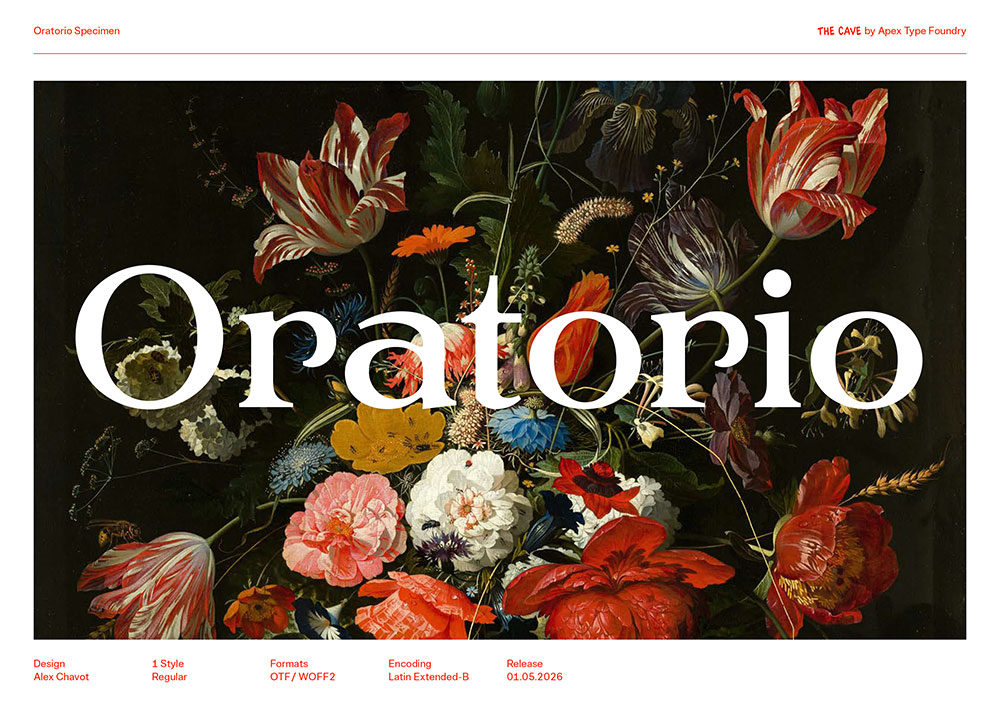
Oratorio is what happens when a Jugendstil tenor meets a 1970s American funk band in a phototypesetting studio. Ornamental excess meets typographic swagger—with just enough restraint to keep it printable.
Originally conceived as a dramatic serif revival, Oratorio gradually blended Baroque intensity with contemporary finesse. Rooted in the expressive rhythms of “Halbfette Cantate” (a display face released around 1910 by H. Berthold AG and designed by Johann Graf), Oratorio infuses sweeping swashes and lyrical terminals reminiscent of Ed Benguiat’s flamboyant 1970s classics. The result is a hybrid typeface with a rich, theatrical voice —unapologetically bold yet unmistakably modern.
Oratorio thrives in display settings (editorial headlines, book and record covers, posters) where its generous forms and high contrast command attention—especially in full caps lock! Digitally redrawn with precision and historical sensitivity, it reinvents typographic excess with elegance and intent.
Though it comes in just one weight, Oratorio is anything but limited: its four sets of initial capital forms, numerous alternates, and robust OpenType features offer a wide range of expressive options to play around with.
Oratorio is no pastiche—it’s a celebration of expressive type at its most eloquent.
Download PDF
You may also like
 View all