
The following OpenType features are included in this font:
GENTLEMEN
INGENIOSOS
Western Literature
Chivalric Romance
Three Musketeers (1844)
Cyrano de Bergerac (1897)
Most-translated book in the world
The best-selling novel of all time
A remarkable behind-the-scenes look at a movie that wasn’t, “Lost in La Mancha” is an incisive, entertaining document of the difficulties inherent in the moviemaking process.
This is more a film about an internal struggle in an artist’s mind. What is it like for an artist to be standing on the brink of actually finishing this project finally?
Finding the source material written by Miguel de Cervantes too vast, Gilliam and his co-writer decided to create their own version of the Quixote story. They made a major change inspired by Mark Twain’s 1889 novel “A Connecticut Yankee in King Arthur’s Court”. They planned to have the character of Sancho Panza appear only early in the film. He was to be replaced by character Toby Grisoni, a 21st-century marketing executive thrown back through time, whom Don Quixote mistakes for Panza. Gilliam was excited about the film, as he felt that the story of Don Quixote embodies many of his own themes (such as the individual versus society, the concept of sanity, etc.). He intended to film it entirely in Spain and other nations in Europe. Jean Rochefort was cast to play Don Quixote, in preparation for which he spent seven months learning English.
“The Man Who Killed Don Quixote” is a 2018 adventure–comedy film directed by Terry Gilliam and written by Gilliam and Tony Grisoni, loosely based on the 1605/1615 novel “Don Quixote” by Miguel de Cervantes. Gilliam tried to make the film many times over 29 years, which made it an infamous example of development hell. Gilliam started work on the film in 1989 but was unable to secure funding until 1998 when it entered full pre-production with a budget of $32.1 million without American financing, with Jean Rochefort as Quixote, Johnny Depp as Toby Grummett—a 21st-century marketing executive thrown back through time—and Vanessa Paradis as the female lead. Shooting began in 2000 in Navarre, but difficulties such as sets and equipment being destroyed by flooding, the departure of Rochefort due to illness, problems obtaining insurance for the production and other financial difficulties led to a sudden suspension of the production and its subsequent cancellation. The original production was the subject of the documentary film “Lost in La Mancha”, which was intended to be a making-of but was released on its own in 2002. Gilliam’s repeated attempts to relaunch production between 2003 and 2016 included Depp, Ewan McGregor and Jack O’Connell as Toby; and Robert Duvall, Michael Palin and John Hurt as Quixote. All were cancelled for various reasons, such as failing to secure funds, Depp’s busy schedule and eventual loss of interest in the project, and Hurt being diagnosed with cancer that eventually led to his death. After yet another failed attempt, it was reported in March 2017 that filming had finally started, with Adam Driver, who was confirmed as Toby in 2016 and helped secure funding, and Jonathan Pryce, who had been part of the original 2000 production in a different role, as Quixote. On 4 June 2017, Gilliam announced that the shooting of the film was complete, 17 years after it originally started. The final version of the film is set in modern-day rural Spain and features Toby as a director, shooting commercials; and “Quixote” as an insane shoemaker convinced that he is the character from Cervantes’ novel. The film premiered on 19 May 2018, simultaneously acting as the closing film at the 2018 Cannes Film Festival and being released in French theaters.
Informations
aalt
c2sc
calt
case
ccmp
cpsp
dlig
dnom
frac
hist
kern
liga
lnum
locl
numr
onum
ordn
pnum
sinf
smcp
ss01
ss02
ss03
subs
sups
tnum
zero
- 123 SS01Open circled figures
- 456 SS02Close circled figures
- ←↑→↓ SS03Alternative arrows
Glyphset
A
Uppercases
A
B
C
D
E
F
G
H
I
J
K
L
M
N
O
P
Q
R
S
T
U
V
W
X
Y
Z
Small Capitals
a
b
c
d
e
f
g
h
i
j
k
l
m
n
o
p
q
r
s
t
u
v
w
x
y
z
Lowercases
a
b
c
d
e
f
g
h
i
j
k
l
m
n
o
p
q
r
s
t
u
v
w
x
y
z
Accented Uppercases
À
Á
Â
Ã
Ä
Ā
Ă
Å
Ǻ
Ą
Æ
Ǽ
Ć
Ĉ
Č
Ċ
Ç
Ď
Đ
È
É
Ê
Ẽ
Ě
Ë
Ē
Ĕ
Ė
Ę
Ĝ
Ǧ
Ḡ
Ğ
Ġ
Ģ
Ĥ
Ħ
Ì
Í
Î
Ĩ
Ï
Ī
Ĭ
İ
Į
IJ
Ĵ
Ķ
Ĺ
Ľ
Ļ
Ł
Ŀ
Ń
Ň
Ñ
Ņ
Ò
Ó
Ô
Õ
Ö
Ō
Ŏ
Ő
Ǫ
Ø
Ǿ
Œ
Ŕ
Ř
Ŗ
ẞ
Ś
Ŝ
Š
Ş
Ș
Ť
Ț
Ţ
Ŧ
Ù
Ú
Û
Ũ
Ü
Ū
Ŭ
Ů
Ű
Ų
Ẁ
Ẃ
Ŵ
Ẅ
Ỳ
Ý
Ŷ
Ỹ
Ÿ
Ȳ
Ź
Ž
Ż
Ə
Ɲ
Ŋ
Ð
Þ
DŽ
Dž
LJ
Lj
NJ
Nj
Accented Small Capitals
à
á
â
ã
ä
ā
ă
å
ǻ
ą
æ
ǽ
ć
ĉ
č
ċ
ç
ď
đ
è
é
ê
ẽ
ě
ë
ē
ĕ
ė
ę
ĝ
ǧ
ḡ
ğ
ġ
ģ
ĥ
ħ
ì
í
î
ĩ
ï
ī
ĭ
i̇
į
ij
ĵ
ķ
ĺ
ľ
ļ
ł
ŀ
ń
ň
ñ
ņ
ò
ó
ô
õ
ö
ō
ŏ
ő
ǫ
ø
ǿ
œ
ŕ
ř
ŗ
ß
ś
ŝ
š
ş
ș
ť
ț
ţ
ŧ
ù
ú
û
ũ
ü
ū
ŭ
ů
ű
ų
ẁ
ẃ
ŵ
ẅ
ỳ
ý
ŷ
ỹ
ÿ
ȳ
ź
ž
ż
ə
ɲ
ŋ
ð
þ
dž
dž
lj
lj
nj
nj
Accented Lowercases
à
á
â
ã
ä
ā
ă
å
ǻ
ą
æ
ǽ
ć
ĉ
č
ċ
ç
ď
đ
è
é
ê
ẽ
ě
ë
ē
ĕ
ė
ę
ĝ
ǧ
ḡ
ğ
ġ
ģ
ĥ
ħ
ì
í
î
ĩ
ï
ī
ĭ
i
į
ı
ij
ĵ
ȷ
ķ
ĺ
ľ
ļ
ł
ŀ
ń
ň
ñ
ʼn
ņ
ò
ó
ô
õ
ö
ō
ŏ
ő
ǫ
ø
ǿ
œ
ŕ
ř
ŗ
ś
ŝ
š
ş
ș
ß
ť
ț
ţ
ŧ
ù
ú
û
ũ
ü
ū
ŭ
ů
ű
ų
ẁ
ẃ
ŵ
ẅ
ỳ
ý
ŷ
ỹ
ÿ
ȳ
ź
ž
ż
ə
ɲ
ŋ
ð
þ
dž
lj
nj
Superior letters
a
b
c
d
e
f
g
h
i
j
k
l
m
n
o
p
q
r
s
t
u
v
w
x
y
z
Inferior letters
a
b
c
d
e
f
g
h
i
j
k
l
m
n
o
p
q
r
s
t
u
v
w
x
y
z
Ligatures
WWW
www
Th
Wh
ſ
fb
ffb
ff
fh
ffh
fi
fì
fí
fî
fï
fį
ffi
ffì
ffí
ffî
ffï
ffį
fj
ffj
fk
ffk
fl
ffl
ft
fft
tt
Discretionary ligatures
ct
sp
st
Diacritics
́
̋
̂
̌
̆
̊
̇
̈
̃
̄
·
·
̀
́
̋
̂
̌
̆
̊
̇
̈
̃
̄
̒
̦
̧
̨
Lining figures and currencies
#
0
1
2
3
4
5
6
7
8
9
€
$
₿
¢
£
₺
ƒ
¥
₸
฿
₴
₽
₹
₪
₩
₫
Old style figures and currencies
#
0
1
2
3
4
5
6
7
8
9
€
$
₿
¢
£
₺
ƒ
¥
₸
฿
₴
₽
₹
₪
₩
₫
Tabular figures and currencies
#
0
1
2
3
4
5
6
7
8
9
€
$
₿
¢
£
₺
ƒ
¥
₸
฿
₴
₽
₹
₪
₩
₫
Tabular old style figures and currencies
#
0
1
2
3
4
5
6
7
8
9
€
$
₿
¢
£
₺
ƒ
¥
₸
฿
₴
₽
₹
₪
₩
₫
Slashed Zeros
0
Mathematical symbols
+
−
±
×
÷
=
≠
~
≈
^
¬
⌀
¤
<
>
≤
≥
∞
◊
Δ
Ω
∂
∫
√
∑
∏
π
μ
°
ℓ
℮
〈
〉
【
】
「
」
《
》
〔
〕
〖
〗
『
』
Case sensitive mathematical symbols
+
−
×
÷
=
≠
~
≈
¬
<
>
Superior figures
,
.
(
)
+
−
×
÷
=
0
1
2
3
4
5
6
7
8
9
Inferior figures
,
.
(
)
+
−
×
÷
=
0
1
2
3
4
5
6
7
8
9
Numerators
,
.
(
)
+
−
×
÷
=
0
1
2
3
4
5
6
7
8
9
Denominators
,
.
(
)
+
−
×
÷
=
0
1
2
3
4
5
6
7
8
9
Open circled figures
0
1
2
3
4
5
6
7
8
9
10
Close circled figures
0
1
2
3
4
5
6
7
8
9
10
Fractions
⁄
%
‰
¼
½
¾
⅛
⅜
⅝
⅞
Roman figures
Ⅰ
Ⅱ
Ⅲ
Ⅳ
Ⅴ
Ⅵ
Ⅶ
Ⅷ
Ⅸ
Ⅼ
Ⅽ
Ⅾ
Ⅿ
Standard punctuation
,
;
:
.
…
-
!
¡
?
¿
‽
⸮
@
‘
’
“
”
‚
„
‘
“
‹
›
«
»
&
/
\
|
¦
_
–
—
•
·
(
)
[
]
{
}
*
⁂
†
‡
§
¶
Case sensitive punctuation
-
–
—
·
‹
›
«
»
(
)
[
]
{
}
¡
¿
@
Abbreviations
℃
℉
℀
℁
℆
℅
©
℗
®
™
℠
ª
º
№
Geometrical symbols
■
□
◆
◇
●
○
◧
◨
⬒
⬓
◩
⬔
⬕
◪
⬖
⬗
⬘
⬙
◐
◑
◓
◒
◀
▶
▲
▼
◁
▷
△
▽
◂
▸
▴
▾
◃
▹
▵
▿
⏏
⏪
⏩
⏫
⏬
⏮
⏭
⏯
⏸
⏹
⏺
Miscellaneous symbols
✴
✳
✺
☀
☼
☽
☾
⚡
☁
⚙
♀
♂
⚲
⚫
⚪
◉
◎
🔍
🔎
🔒
🔓
≡
❌
⌘
♥
♡
⚑
⚐
★
☆
❤
♠
♣
♦
✓
✗
☐
☑
☒
❏
❍
◌
Arrows
←
↑
→
↓
↖
↗
↘
↙
↔
↕
➤
➣
➢
↰
↱
↲
↳
⬑
⬏
⬐
⬎
⭰
⭲
⭱
⭳
ꜜ
🔀
🔁
🔂
⮀
⮂
⮁
⮃
⮌
⮎
⮏
⮍
🔃
🔄
⟳
⟲
Alternative arrows
←
↑
→
↓
Languages
Abenaki, Afaan Oromo, Afar, Afrikaans, Albanian, Alsatian, Amis, Anuta, Aragonese, Aranese, Aromanian, Arrernte, Arvanitic, Asturian, Atayal, Aymara, Azerbaijani, Bashkir, Basque, Belarusian, Bemba, Bikol, Bislama, Bosnian, Breton, Cape Verdean Creole, Catalan, Cebuano, Chamorro, Chavacano, Chichewa, Chickasaw, Cimbrian, Cofán, Cornish, Corsican, Creek, Crimean Tatar, Croatian, Czech, Danish, Dawan, Delaware, Dholuo, Drehu, Dutch, English, Esperanto, Estonian, Faroese, Fijian, Filipino, Finnish, Folkspraak, French, Frisian, Friulian, Gagauz, Galician, Ganda, Genoese, German, Gikuyu, Gooniyandi, Greenlandic, Guadeloupean Creole, Gwich'in, Haitian Creole, Hän, Hawaiian, Hiligaynon, Hopi, Hotcąk, Hungarian, Icelandic, Ido, Igbo, Ilocano, Indonesian, Interglossa, Interlingua, Irish, Istro-Romanian, Italian, Jamaican, Javanese, Jèrriais, Kaingang, Kala Lagaw Ya, Kapampangan, Kaqchikel, Karakalpak, Karelian, Kashubian, Kikongo, Kinyarwanda, Kiribati, Kirundi, Klingon, Kurdish, Ladin, Latin, Latino sine Flexione, Latvian, Lithuanian, Lojban, Lombard, Low Saxon, Luxembourgish, Maasai, Makhuwa, Malay, Maltese, Manx, Māori, Marquesan, Megleno-Romanian, Meriam Mir, Mirandese, Mohawk, Moldovan, Montagnais, Montenegrin, Murrinh-Patha, Nagamese Creole, Nahuatl, Ndebele, Neapolitan, Ngiyambaa, Niuean, Noongar, Norwegian, Novial, Occidental, Occitan, Old Icelandic, Old Norse, Onĕipŏt, Oshiwambo, Ossetian, Palauan, Papiamento, Piedmontese, Polish, Portuguese, Potawatomi, Q'eqchi', Quechua, Rarotongan, Romanian, Romansh, Rotokas, Sami, Samoan, Sango, Saramaccan, Sardinian, Scottish Gaelic, Serbian, Seri, Seychellois Creole, Shawnee, Shona, Sicilian, Silesian, Slovak, Slovenian, Slovio, Somali, Sorbian, Sotho, Spanish, Sranan, Sundanese, Swahili, Swazi, Swedish, Tagalog, Tahitian, Tetum, Tok Pisin, Tokelauan, Tongan, Tshiluba, Tsonga, Tswana, Tumbuka, Turkish, Turkmen, Tuvaluan, Tzotzil, Uzbek, Venetian, Vepsian, Volapük, Võro, Wallisian, Walloon, Waray-Waray, Warlpiri, Wayuu, Welsh, Wik-Mungkan, Wiradjuri, Wolof, Xavante, Xhosa, Yapese, Yindjibarndi, Zapotec, Zarma, Zazaki, Zulu, Zuni
About
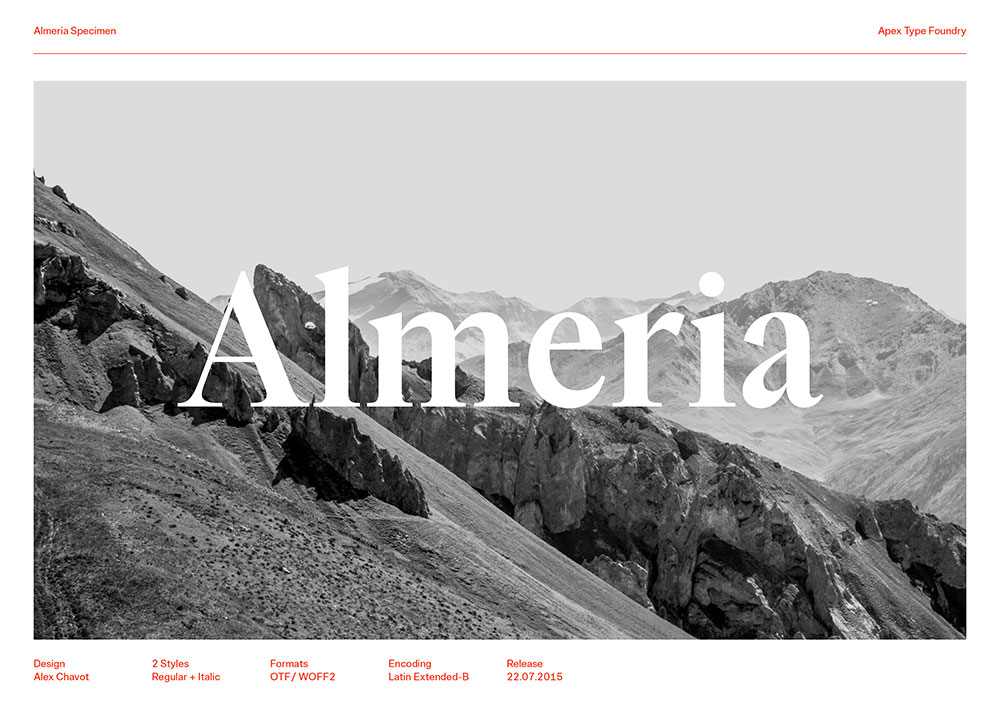
Almeria is a bold and distinctive serif family that shuns historical models or direct revivals. Much like the tales of the knight-errant it illustrates in this specimen, it is (almost) only born from its author’s mind.
The typeface takes its name and soul from the arid, sun-drenched landscapes of Southern Spain. Its design echoes the striking contrasts of Andalusian architecture—where the defensive, razor-edged lines of stone fortresses meet the fluid, organic grace of Moorish calligraphic details. This tension results in a rhythmic and “gripping” visual texture: sharp, assertive terminals balanced by elegant, generous bowls.
While Almeria’s slightly condensed width and sturdy structure offer a dense, deep typographic grey in running text, its idiosyncratic details naturally lean towards display use. It is a face that “bites” the paper, revealing its singular personality when given the space to breathe.
Available in two essential styles—a robust Regular and a spirited Italic—Almeria is a sincere and daring voice for designers seeking a contemporary serif with a soulful, slightly chivalrous edge.
Download PDF
You may also like

 View all