
The following OpenType features are included in this font:
INTERSTELLAR
Disproportionate
PROTEGGENDO
Geomorphologists
BIENVEILLANCE
Electroluminescent
IMPRESSIONARE
Interdenominational
Le refuge Torino est un refuge de montagne italien situé dans le massif du Mont-Blanc à 3375 mètres d’altitude. Il est composé de deux bâtiments distincts, l’ancien refuge en aval et le nouveau refuge en amont, tous deux situés sur l’endroit de la pointe Helbronner, sous les gares de téléphériques du Skyway Monte Bianco et de la télécabine Panoramic Mont-Blanc. Il se trouve juste au sud du col du Géant (3371 mètres) et de la ligne de partage des eaux entre l’Italie et la France et juste au sud-est de la pointe Helbronner à laquelle il est relié par un escalier. Le refuge a été concerné par un litige frontalier entre la France et l’Italie. Entièrement en Italie du point de vue italien, il était sur la frontière franco-italienne du point de vue français, à cheval entre les communes de Courmayeur en Vallée d’Aoste et de Chamonix-Mont-Blanc en Haute-Savoie. Le tracé de la frontière a été modifié sur les dernières cartes IGN, qui suit désormais la ligne de partage des eaux à cet endroit.
La pointe Helbronner est un sommet franco-italien situé dans le massif du Mont-Blanc et qui culmine à 3462 ou 3470 mètres d’altitude. Elle est située entre le Grand Flambeau et les aiguilles Marbrées sur la ligne de partage des eaux entre la Haute-Savoie et la Vallée d’Aoste. Elle est le point d’arrivée du téléphérique italien Skyway Monte Bianco, au départ d’Entrèves près de Courmayeur, et de la télécabine Panoramic Mont-Blanc qui traverse la Vallée Blanche et le glacier du Géant à partir de l’aiguille du Midi, en France. La pointe Helbronner est aussi le point de départ d’une descente à ski du glacier du Géant jusqu’au Montenvers ou même à Chamonix-Mont-Blanc et de plusieurs randonnées aux sommets voisins. La pointe donne une vue imprenable sur la vallée d’Aoste et sur tout le Piémont. Une exposition permanente de 150 cristaux provenant du massif du Mont Blanc a été ouverte au centre visiteurs du Pavillon.
The Mont Blanc massif (French: Massif du Mont-Blanc; Italian: Massiccio del Monte Bianco) is a mountain range in the Alps, located mostly in France and Italy, but also straddling Switzerland at its northeastern end. It contains eleven major independent summits, each over 4,000 metres (13,123 ft) in height. It is named after Mont Blanc (4,808 metres [15,774 ft]), the highest point in western Europe and the European Union. Because of its considerable overall altitude, a large proportion of the massif is covered by glaciers, which include the Mer de Glace and the Miage Glacier—the longest glaciers in France and Italy, respectively. The massif forms a watershed between the vast catchments of the rivers Rhône and Po, and a tripoint between France, Italy and Switzerland; it also marks the border between two climate regions by separating the northern and western Alps from the southern Alps. The mountains of the massif consist mostly of granite and gneiss rocks and at high altitudes the vegetation is an arctic-alpine flora. The valleys that delimit the massif were used as communication routes by the Romans until they left around the 5th century AD. The region remained of some military importance through to the mid-20th century. A peasant farming economy operated within these valleys for many centuries until the glaciers and mountains were “discovered” by the outside world in the 18th century. Word of these impressive sights began to spread, and Mont Blanc was first climbed in 1786, marking the start of the sport of mountaineering. The region is now a major tourist destination, drawing in over six million visitors per year. It provides a wide range of opportunities for outdoor recreation and activities such as sight-seeing, hiking, rock climbing, mountaineering and skiing. Around one hundred people a year die across its mountains and, occasionally, bodies have been lost and entombed in its glaciers for decades. Access into the mountains is facilitated by cable cars, mountain railways and mountain huts which offer overnight refuge to climbers and skiers. The long-distance Tour du Mont Blanc hiking trail circumnavigates the whole massif in an 11-day trek of 170 kilometres (110 mi). The Mont Blanc Tunnel connects the French town of Chamonix on the northern side with the Italian town of Courmayeur in the south. The high mountains have provided many opportunities for scientific research, including neutrino measurements within the tunnel and impact of climate change on its highest slopes. Recent rises in average temperatures have led to significant glacial retreat across the massif and an awareness of the need for better environmental protection, including a call for World Heritage Site status.
Informations
aalt
c2sc
calt
case
ccmp
cpsp
dlig
dnom
frac
hist
kern
liga
lnum
locl
numr
onum
ordn
pnum
sinf
smcp
ss01
ss02
ss03
ss04
ss05
ss06
ss07
ss08
ss09
subs
sups
tnum
zero
- Stanzaia SS01Alternative a
- Aggiungi SS02Alternative g
- Ferrari SS03Alternative r
- Bottino SS04Alternative t
- Style SS05Alternative y
Glyphset
A
Uppercases
A
B
C
D
E
F
G
H
I
J
K
L
M
N
O
P
Q
R
S
T
U
V
W
X
Y
Z
Small Capitals
a
b
c
d
e
f
g
h
i
j
k
l
m
n
o
p
q
r
s
t
u
v
w
x
y
z
Lowercases
a
b
c
d
e
f
g
h
i
j
k
l
m
n
o
p
q
r
s
t
u
v
w
x
y
z
Accented Uppercases
À
Á
Â
Ã
Ä
Ā
Ă
Å
Ǻ
Ą
Æ
Ǽ
Ć
Ĉ
Č
Ċ
Ç
Ď
Đ
È
É
Ê
Ẽ
Ě
Ë
Ē
Ĕ
Ė
Ę
Ĝ
Ǧ
Ḡ
Ğ
Ġ
Ģ
Ĥ
Ħ
Ì
Í
Î
Ĩ
Ï
Ī
Ĭ
İ
Į
IJ
Ĵ
Ķ
Ĺ
Ľ
Ļ
Ł
Ŀ
Ń
Ň
Ñ
Ņ
Ò
Ó
Ô
Õ
Ö
Ō
Ŏ
Ő
Ǫ
Ø
Ǿ
Œ
Ŕ
Ř
Ŗ
ẞ
Ś
Ŝ
Š
Ş
Ș
Ť
Ț
Ţ
Ŧ
Ù
Ú
Û
Ũ
Ü
Ū
Ŭ
Ů
Ű
Ų
Ẁ
Ẃ
Ŵ
Ẅ
Ỳ
Ý
Ŷ
Ỹ
Ÿ
Ȳ
Ź
Ž
Ż
Ə
Ɲ
Ŋ
Ð
Þ
DŽ
Dž
LJ
Lj
NJ
Nj
Accented Small Capitals
à
á
â
ã
ä
ā
ă
å
ǻ
ą
æ
ǽ
ć
ĉ
č
ċ
ç
ď
đ
è
é
ê
ẽ
ě
ë
ē
ĕ
ė
ę
ĝ
ǧ
ḡ
ğ
ġ
ģ
ĥ
ħ
ì
í
î
ĩ
ï
ī
ĭ
i̇
į
ij
ĵ
ķ
ĺ
ľ
ļ
ł
ŀ
ń
ň
ñ
ņ
ò
ó
ô
õ
ö
ō
ŏ
ő
ǫ
ø
ǿ
œ
ŕ
ř
ŗ
ß
ś
ŝ
š
ş
ș
ť
ț
ţ
ŧ
ù
ú
û
ũ
ü
ū
ŭ
ů
ű
ų
ẁ
ẃ
ŵ
ẅ
ỳ
ý
ŷ
ỹ
ÿ
ȳ
ź
ž
ż
ə
ɲ
ŋ
ð
þ
dž
lj
nj
Accented Lowercases
à
á
â
ã
ä
ā
ă
å
ǻ
ą
æ
ǽ
ć
ĉ
č
ċ
ç
ď
đ
è
é
ê
ẽ
ě
ë
ē
ĕ
ė
ę
ĝ
ǧ
ḡ
ğ
ġ
ģ
ĥ
ħ
ì
í
î
ĩ
ï
ī
ĭ
i
į
ı
ij
ĵ
ȷ
ķ
ĺ
ľ
ļ
ł
ŀ
ń
ň
ñ
ʼn
ņ
ò
ó
ô
õ
ö
ō
ŏ
ő
ǫ
ø
ǿ
œ
ŕ
ř
ŗ
ś
ŝ
š
ş
ș
ß
ť
ț
ţ
ŧ
ù
ú
û
ũ
ü
ū
ŭ
ů
ű
ų
ẁ
ẃ
ŵ
ẅ
ỳ
ý
ŷ
ỹ
ÿ
ȳ
ź
ž
ż
ə
ɲ
ŋ
ð
þ
dž
lj
nj
Alternates
a
a
à
á
â
ã
ä
ā
ă
å
ǻ
ą
æ
ǽ
g
ĝ
ǧ
ḡ
ğ
ġ
ģ
r
ŕ
ř
ŗ
t
ť
ț
ţ
ŧ
y
ỳ
ý
ŷ
ỹ
ÿ
ȳ
Superior letters
A
B
C
D
E
F
G
H
I
J
K
L
M
N
O
P
Q
R
S
T
U
V
W
X
Y
Z
a
b
c
d
e
f
g
h
i
j
k
l
m
n
o
p
q
r
s
t
u
v
w
x
y
z
Inferior letters
A
B
C
D
E
F
G
H
I
J
K
L
M
N
O
P
Q
R
S
T
U
V
W
X
Y
Z
a
b
c
d
e
f
g
h
i
j
k
l
m
n
o
p
q
r
s
t
u
v
w
x
y
z
Ligatures
WWW
www
Th
fb
ffb
ff
fh
ffh
fi
ffi
fj
ffj
fk
ffk
fl
ffl
ft
fft
tt
Diacritics
́
̋
̂
̌
̆
̊
̇
̈
̃
̄
·
·
̀
́
̋
̂
̌
̆
̊
̇
̈
̃
̄
̒
̦
̧
̨
Lining figures and currencies
#
0
0
1
2
3
4
5
6
7
8
9
€
$
₿
¢
£
₺
ƒ
¥
₸
฿
₴
₽
₹
₪
₩
₫
Old style figures and currencies
#
0
0
1
2
3
4
5
6
7
8
9
€
$
₿
¢
£
₺
ƒ
¥
₸
฿
₴
₽
₹
₪
₩
₫
Tabular figures and currencies
#
0
0
1
2
3
4
5
6
7
8
9
€
$
₿
¢
£
₺
ƒ
¥
₸
฿
₴
₽
₹
₪
₩
₫
Tabular old style figures and currencies
#
0
0
1
2
3
4
5
6
7
8
9
€
$
₿
¢
£
₺
ƒ
¥
₸
฿
₴
₽
₹
₪
₩
₫
Slashed Zeros
0
Mathematical symbols
+
−
±
×
÷
=
≠
~
≈
^
¬
⌀
¤
<
>
≤
≥
∞
◊
Δ
Ω
∂
∫
√
∑
∏
π
μ
°
ℓ
℮
〈
〉
【
】
「
」
《
》
〔
〕
〖
〗
『
』
Case sensitive mathematical symbols
+
−
×
÷
=
≠
~
≈
¬
<
>
Superior figures
,
.
(
)
+
−
×
÷
=
0
1
2
3
4
5
6
7
8
9
Inferior figures
,
.
(
)
+
−
×
÷
=
0
1
2
3
4
5
6
7
8
9
Numerators
,
.
(
)
+
−
×
÷
=
0
1
2
3
4
5
6
7
8
9
Denominators
,
.
(
)
+
−
×
÷
=
0
1
2
3
4
5
6
7
8
9
Open circled figures
0
1
2
3
4
5
6
7
8
9
10
Close circled figures
0
1
2
3
4
5
6
7
8
9
10
Fractions
⁄
%
‰
¼
½
¾
⅛
⅜
⅝
⅞
Roman figures
Ⅰ
Ⅱ
Ⅲ
Ⅳ
Ⅴ
Ⅵ
Ⅶ
Ⅷ
Ⅸ
Ⅼ
Ⅽ
Ⅾ
Ⅿ
Standard punctuation
,
;
:
.
…
-
!
¡
?
¿
‽
⸮
@
‘
’
“
”
‚
„
‘
“
‹
›
«
»
&
/
\
|
¦
_
–
—
•
·
(
)
[
]
{
}
*
⁂
†
‡
§
¶
Case sensitive punctuation
-
–
—
·
‹
›
«
»
(
)
[
]
{
}
¡
¿
@
Abbreviations
℃
℉
℀
℁
℆
℅
©
℗
®
™
℠
ª
º
№
Geometrical symbols
■
□
◆
◇
●
○
◧
◨
⬒
⬓
◩
⬔
⬕
◪
⬖
⬗
⬘
⬙
◐
◑
◓
◒
◀
▶
▲
▼
◁
▷
△
▽
◂
▸
▴
▾
◃
▹
▵
▿
⏏
⏪
⏩
⏫
⏬
⏮
⏭
⏯
⏸
⏹
⏺
Miscellaneous symbols
✴
✳
✺
☀
☼
☽
☾
⚡
☁
⚙
♀
♂
⚲
⚫
⚪
◉
◎
🔍
🔎
🔒
🔓
≡
❌
⌘
♥
♡
⚑
⚐
★
☆
❤
♠
♣
♦
✓
✗
☐
☑
☒
❏
❍
◌
Arrows
←
↑
→
↓
↖
↗
↘
↙
↔
↕
➤
➣
➢
↰
↱
↲
↳
⬑
⬏
⬐
⬎
⭰
⭲
⭱
⭳
ꜜ
🔀
🔁
🔂
⮀
⮂
⮁
⮃
⮌
⮎
⮏
⮍
🔃
🔄
⟳
⟲
Languages
Abenaki, Afaan Oromo, Afar, Afrikaans, Albanian, Alsatian, Amis, Anuta, Aragonese, Aranese, Aromanian, Arrernte, Arvanitic, Asturian, Atayal, Aymara, Azerbaijani, Bashkir, Basque, Belarusian, Bemba, Bikol, Bislama, Bosnian, Breton, Cape Verdean Creole, Catalan, Cebuano, Chamorro, Chavacano, Chichewa, Chickasaw, Cimbrian, Cofán, Cornish, Corsican, Creek, Crimean Tatar, Croatian, Czech, Danish, Dawan, Delaware, Dholuo, Drehu, Dutch, English, Esperanto, Estonian, Faroese, Fijian, Filipino, Finnish, Folkspraak, French, Frisian, Friulian, Gagauz, Galician, Ganda, Genoese, German, Gikuyu, Gooniyandi, Greenlandic, Guadeloupean Creole, Gwich'in, Haitian Creole, Hän, Hawaiian, Hiligaynon, Hopi, Hotcąk, Hungarian, Icelandic, Ido, Igbo, Ilocano, Indonesian, Interglossa, Interlingua, Irish, Istro-Romanian, Italian, Jamaican, Javanese, Jèrriais, Kaingang, Kala Lagaw Ya, Kapampangan, Kaqchikel, Karakalpak, Karelian, Kashubian, Kikongo, Kinyarwanda, Kiribati, Kirundi, Klingon, Kurdish, Ladin, Latin, Latino sine Flexione, Latvian, Lithuanian, Lojban, Lombard, Low Saxon, Luxembourgish, Maasai, Makhuwa, Malay, Maltese, Manx, Māori, Marquesan, Megleno-Romanian, Meriam Mir, Mirandese, Mohawk, Moldovan, Montagnais, Montenegrin, Murrinh-Patha, Nagamese Creole, Nahuatl, Ndebele, Neapolitan, Ngiyambaa, Niuean, Noongar, Norwegian, Novial, Occidental, Occitan, Old Icelandic, Old Norse, Onĕipŏt, Oshiwambo, Ossetian, Palauan, Papiamento, Piedmontese, Polish, Portuguese, Potawatomi, Q'eqchi', Quechua, Rarotongan, Romanian, Romansh, Rotokas, Sami, Samoan, Sango, Saramaccan, Sardinian, Scottish Gaelic, Serbian, Seri, Seychellois Creole, Shawnee, Shona, Sicilian, Silesian, Slovak, Slovenian, Slovio, Somali, Sorbian, Sotho, Spanish, Sranan, Sundanese, Swahili, Swazi, Swedish, Tagalog, Tahitian, Tetum, Tok Pisin, Tokelauan, Tongan, Tshiluba, Tsonga, Tswana, Tumbuka, Turkish, Turkmen, Tuvaluan, Tzotzil, Uzbek, Venetian, Vepsian, Volapük, Võro, Wallisian, Walloon, Waray-Waray, Warlpiri, Wayuu, Welsh, Wik-Mungkan, Wiradjuri, Wolof, Xavante, Xhosa, Yapese, Yindjibarndi, Zapotec, Zarma, Zazaki, Zulu, Zuni
About
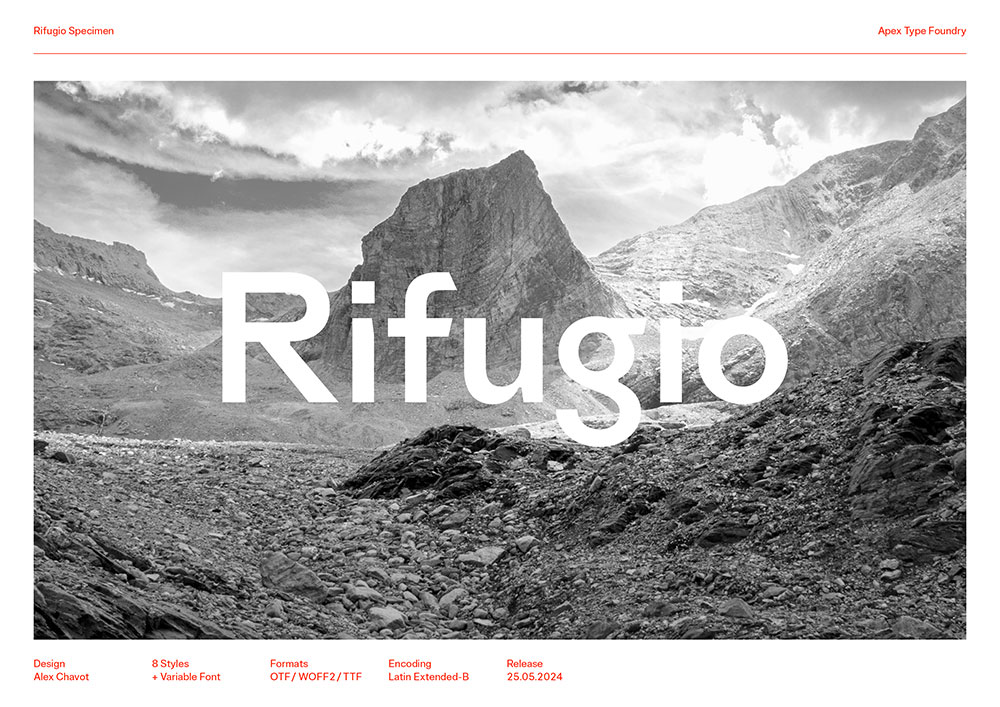
The starting point for Rifugio was coming across Nebiolo’s 407 Bastone series, a quirky wide caps-only grotesque with unusual proportions and very unsubtle traits, as if Helvetica had ventured south through the Alps and indulged in one too many Campari cocktails…
Rifugio takes it from there, revisiting the bold heritage of Aldo Novarese and the vitality of the ’50s and ’60s Italian typography. High-waisted capitals and carefully crafted pseudo-naive whimsical letterforms give Rifugio its warm, charming, and distinctive personality, adding a touch of vernacular typography and backcountry signage vibes to an otherwise well-balanced functional sans. Rifugio offers a comprehensive set of weights ranging from Thin to Black—as well as a variable font format—allowing its unique personality to shine in all demanding situations. Well-equipped with a variety of OpenType features (including small caps, superiors, inferiors, four types of figures, ligatures…) and a bunch of alternates, Rifugio provides a rich typographic palette to meet the needs of contemporary design.
Friendly, dynamic and charismatic, Rifugio is a dazzling fusion of Italian flair and modern flexibility which undoubtedly offers a high level of personality in titling while fully delivering on functionality in complex settings.
Download PDF
You may also like

 View all