
The following OpenType features are included in this font:
Industrialized
FICTITIOUS
Structure
CAMERA
Normal
The Treasure of the Sierra Madre
The Passion of Joann of Arc
Night of the Living Dead
The Grapes of Wrath
The Maltese Falcon
Taxi Driver stands at the peak of the vital, gritty auteur driven filmmaking that defined 1970s New Hollywood.
Informations
aalt
calt
case
ccmp
cpsp
dnom
frac
hist
kern
liga
lnum
locl
numr
onum
ordn
pnum
sinf
ss01
ss02
ss03
ss04
ss05
ss06
ss07
ss08
ss09
ss10
subs
sups
tnum
zero
- Bogart ss01Alternative a
- Siegel ss02Alternative g
- Prijs ss03Alternative j
- Brest ss04Alternative r
- Horst ss05Alternative t
- Taylor ss06Alternative y
Glyphset
A
Uppercases
A
B
C
D
E
F
G
H
I
J
K
L
M
N
O
P
Q
R
S
T
U
V
W
X
Y
Z
Lowercases
a
b
c
d
e
f
g
h
i
j
k
l
m
n
o
p
q
r
s
t
u
v
w
x
y
z
Accented Uppercases
À
Á
Â
Ã
Ä
Ā
Ă
Å
Ǻ
Ą
Æ
Ǽ
Ć
Ĉ
Č
Ċ
Ç
Ď
Đ
È
É
Ê
Ẽ
Ě
Ë
Ē
Ĕ
Ė
Ę
Ĝ
Ǧ
Ḡ
Ğ
Ġ
Ģ
Ĥ
Ħ
Ì
Í
Î
Ĩ
Ï
Ī
Ĭ
İ
Į
IJ
Ĵ
Ķ
Ĺ
Ľ
Ļ
Ł
Ŀ
Ń
Ň
Ñ
Ņ
Ò
Ó
Ô
Õ
Ö
Ō
Ŏ
Ő
Ǫ
Ø
Ǿ
Œ
Ŕ
Ř
Ŗ
ẞ
Ś
Ŝ
Š
Ş
Ș
Ť
Ț
Ţ
Ŧ
Ù
Ú
Û
Ũ
Ü
Ū
Ŭ
Ů
Ű
Ų
Ẁ
Ẃ
Ŵ
Ẅ
Ỳ
Ý
Ŷ
Ỹ
Ÿ
Ȳ
Ź
Ž
Ż
Ə
Ɲ
Ŋ
Ð
Þ
DŽ
Dž
LJ
Lj
NJ
Nj
Accented Lowercases
à
á
â
ã
ä
ā
ă
å
ǻ
ą
æ
ǽ
ć
ĉ
č
ċ
ç
ď
đ
è
é
ê
ẽ
ě
ë
ē
ĕ
ė
ę
ĝ
ǧ
ḡ
ğ
ġ
ģ
ĥ
ħ
ì
í
î
ĩ
ï
ī
ĭ
i
į
ı
ij
ĵ
ȷ
ķ
ĺ
ľ
ļ
ł
ŀ
ń
ň
ñ
ʼn
ņ
ò
ó
ô
õ
ö
ō
ŏ
ő
ǫ
ø
ǿ
œ
ŕ
ř
ŗ
ś
ŝ
š
ş
ș
ß
ť
ț
ţ
ŧ
ù
ú
û
ũ
ü
ū
ŭ
ů
ű
ų
ẁ
ẃ
ŵ
ẅ
ỳ
ý
ŷ
ỹ
ÿ
ȳ
ź
ž
ż
ə
ɲ
ŋ
ð
þ
dž
lj
nj
Alternates
a
à
á
â
ã
ä
ā
ă
å
ǻ
ą
æ
ǽ
g
ĝ
ǧ
ḡ
ğ
ġ
ģ
j
ij
ĵ
ȷ
r
ŕ
ř
ŗ
t
ť
ț
ţ
ŧ
y
ỳ
ý
ŷ
ỹ
ÿ
ȳ
lj
nj
&
Ligatures
Th
ſ
fb
ffb
ff
fh
ffh
fi
fì
fí
fî
fï
fį
ffi
ffì
ffí
ffî
ffï
ffį
fj
fj
ffj
ffj
fk
ffk
fl
ffl
ft
ft
fft
fft
tt
tt
Diacritics
́
̋
̂
̌
̆
̊
̇
̈
̃
̄
·
·
̀
́
̋
̂
̌
̆
̊
̇
̈
̃
̄
̒
̦
̧
̨
Lining figures and currencies
#
0
1
2
3
4
5
6
7
8
9
€
$
₿
¢
£
₺
ƒ
¥
₸
฿
₴
₽
₹
₪
₩
₫
Old style figures and currencies
#
0
1
2
3
4
5
6
7
8
9
€
$
₿
¢
£
₺
ƒ
¥
₸
฿
₴
₽
₹
₪
₩
₫
Tabular figures and currencies
#
0
1
2
3
4
5
6
7
8
9
€
$
₿
¢
£
₺
ƒ
¥
₸
฿
₴
₽
₹
₪
₩
₫
Tabular old style figures and currencies
#
0
1
2
3
4
5
6
7
8
9
€
$
₿
¢
£
₺
ƒ
¥
₸
฿
₴
₽
₹
₪
₩
₫
Slashed Zeros
0
Mathematical symbols
+
−
±
×
÷
=
≠
~
≈
^
¬
⌀
¤
<
>
≤
≥
∞
◊
Δ
Ω
∂
∫
√
∑
∏
π
μ
°
ℓ
℮
〈
〉
【
】
「
」
《
》
〔
〕
〖
〗
『
』
Case sensitive mathematical symbols
+
−
×
÷
=
≠
~
≈
¬
<
>
Superior figures
,
.
(
)
+
−
×
÷
=
0
1
2
3
4
5
6
7
8
9
Inferior figures
,
.
(
)
+
−
×
÷
=
0
1
2
3
4
5
6
7
8
9
Numerators
,
.
(
)
+
−
×
÷
=
0
1
2
3
4
5
6
7
8
9
Denominators
,
.
(
)
+
−
×
÷
=
0
1
2
3
4
5
6
7
8
9
Open circled figures
0
1
2
3
4
5
6
7
8
9
10
Close circled figures
0
1
2
3
4
5
6
7
8
9
10
Fractions
⁄
%
‰
¼
½
¾
⅛
⅜
⅝
⅞
Roman figures
Ⅰ
Ⅱ
Ⅲ
Ⅳ
Ⅴ
Ⅵ
Ⅶ
Ⅷ
Ⅸ
Ⅼ
Ⅽ
Ⅾ
Ⅿ
Standard punctuation
,
;
:
.
…
-
!
¡
?
¿
‽
⸮
@
‘
’
“
”
‚
„
‘
“
‹
›
«
»
&
/
\
|
¦
_
–
—
•
·
(
)
[
]
{
}
*
⁂
†
‡
§
¶
Case sensitive punctuation
-
–
—
·
‹
›
«
»
(
)
[
]
{
}
¡
¿
@
Abbreviations
℃
℉
℀
℀
℁
℁
℆
℅
©
℗
®
™
℠
ª
ª
º
№
Geometrical symbols
■
□
◆
◇
●
○
◧
◨
⬒
⬓
◩
⬔
⬕
◪
⬖
⬗
⬘
⬙
◐
◑
◓
◒
◀
▶
▲
▼
◁
▷
△
▽
◂
▸
▴
▾
◃
▹
▵
▿
⏏
⏪
⏩
⏫
⏬
⏮
⏭
⏯
⏸
⏹
⏺
Miscellaneous symbols
✴
✳
✺
☀
☼
☽
☾
⚡
☁
⚙
♀
♂
⚲
⚫
⚪
◉
◎
🔍
🔎
🔒
🔓
≡
❌
⌘
♥
♡
⚑
⚐
★
☆
❤
♠
♣
♦
✓
✗
☐
☑
☒
❏
❍
◌
Arrows
←
↑
→
↓
↖
↗
↘
↙
↔
↕
➤
➣
➢
↰
↱
↲
↳
⬑
⬏
⬐
⬎
⭰
⭲
⭱
⭳
ꜜ
🔀
🔁
🔂
⮀
⮂
⮁
⮃
⮌
⮎
⮏
⮍
🔃
🔄
⟳
⟲
Languages
Abenaki, Afaan Oromo, Afar, Afrikaans, Albanian, Alsatian, Amis, Anuta, Aragonese, Aranese, Aromanian, Arrernte, Arvanitic, Asturian, Atayal, Aymara, Azerbaijani, Bashkir, Basque, Belarusian, Bemba, Bikol, Bislama, Bosnian, Breton, Cape Verdean Creole, Catalan, Cebuano, Chamorro, Chavacano, Chichewa, Chickasaw, Cimbrian, Cofán, Cornish, Corsican, Creek, Crimean Tatar, Croatian, Czech, Danish, Dawan, Delaware, Dholuo, Drehu, Dutch, English, Esperanto, Estonian, Faroese, Fijian, Filipino, Finnish, Folkspraak, French, Frisian, Friulian, Gagauz, Galician, Ganda, Genoese, German, Gikuyu, Gooniyandi, Greenlandic, Guadeloupean Creole, Gwich'in, Haitian Creole, Hän, Hawaiian, Hiligaynon, Hopi, Hotcąk, Hungarian, Icelandic, Ido, Igbo, Ilocano, Indonesian, Interglossa, Interlingua, Irish, Istro-Romanian, Italian, Jamaican, Javanese, Jèrriais, Kaingang, Kala Lagaw Ya, Kapampangan, Kaqchikel, Karakalpak, Karelian, Kashubian, Kikongo, Kinyarwanda, Kiribati, Kirundi, Klingon, Kurdish, Ladin, Latin, Latino sine Flexione, Latvian, Lithuanian, Lojban, Lombard, Low Saxon, Luxembourgish, Maasai, Makhuwa, Malay, Maltese, Manx, Māori, Marquesan, Megleno-Romanian, Meriam Mir, Mirandese, Mohawk, Moldovan, Montagnais, Montenegrin, Murrinh-Patha, Nagamese Creole, Nahuatl, Ndebele, Neapolitan, Ngiyambaa, Niuean, Noongar, Norwegian, Novial, Occidental, Occitan, Old Icelandic, Old Norse, Onĕipŏt, Oshiwambo, Ossetian, Palauan, Papiamento, Piedmontese, Polish, Portuguese, Potawatomi, Q'eqchi', Quechua, Rarotongan, Romanian, Romansh, Rotokas, Sami, Samoan, Sango, Saramaccan, Sardinian, Scottish Gaelic, Serbian, Seri, Seychellois Creole, Shawnee, Shona, Sicilian, Silesian, Slovak, Slovenian, Slovio, Somali, Sorbian, Sotho, Spanish, Sranan, Sundanese, Swahili, Swazi, Swedish, Tagalog, Tahitian, Tetum, Tok Pisin, Tokelauan, Tongan, Tshiluba, Tsonga, Tswana, Tumbuka, Turkish, Turkmen, Tuvaluan, Tzotzil, Uzbek, Venetian, Vepsian, Volapük, Võro, Wallisian, Walloon, Waray-Waray, Warlpiri, Wayuu, Welsh, Wik-Mungkan, Wiradjuri, Wolof, Xavante, Xhosa, Yapese, Yindjibarndi, Zapotec, Zarma, Zazaki, Zulu, Zuni
About
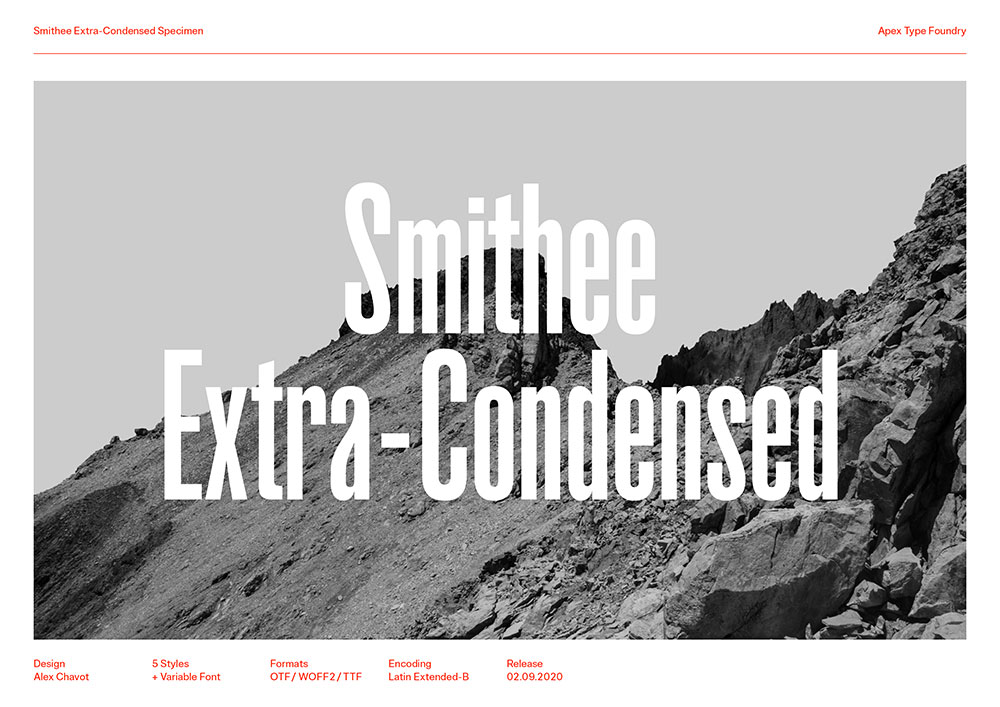
Smithee takes its roots in a vintage wood type specimen from the Fonderie Typographique Française, discovered in the archives of the Musée de l’imprimerie et de la communication graphique in Lyon. The original source appears to be a reissue of the collection from A. Martin & Cie (Ardon, Switzerland), a 20th-century leader in wood type manufacturing.
At the time, these styles fell under the utilitarian designation “Série A” (and “Série C” for heavier weights). We were immediately drawn to the tension between its mechanical, straightforward structure (b, d, p, q) and its more organic, idiosyncratic twists (a, s).
Among the wide range of styles displayed, we focused on the most condensed variant. Its silhouette evokes both Edward Wright’s iconic titling for the 1956 “This Is Tomorrow” exhibition and the archetypal “billing block” credits found at the bottom of movie posters. This cinematic connection inspired the name Smithee, a nod to “Alan Smithee”—the famous pseudonym used by directors who disowned a film after it was recut against their will.
Now available as a variable font, Smithee expands into a 5-weight family to address a vast range of typographic needs. As the weights grow bolder, Smithee’s industrial personality subtly shifts toward a friendlier, quirkier tone. With its straight-sided condensed forms and numerous alternates, Smithee is a daring tool for expressive, high-impact typography.
Download PDF
You may also like
 View all