
The following OpenType features are included in this font:
WALENSTADT
Cinémathèque
Oeschinensee
OLYMPIQUES
Saint-Ursanne
Wasserschloss
FRAUENFELD
TERRITOIRES
Diessenhofen
Zentralschwiiz
Schaffhausen
COLLECTION
LAUSANNOIS
MORGARTEN
Beromünster
Grundsätzlich
ZOLLIKOFEN
ITALIÄNISCH
Trachselwald
Gotthardhaus
Switzerland has maintained a policy of armed neutrality since the 16th century and has not fought an international war since 1815. It joined the Council of Europe in 1964 and the United Nations (UN) in 2002, pursuing an active foreign policy that includes frequent involvement in peace building and global governance. Switzerland is the birthplace of the Red Cross and hosts the headquarters or offices of most major international institutions, including the WTO, the WHO, the ILO, FIFA, the WEF, and the UN. It is a founding member of the European Free Trade Association (EFTA) and participates in the European single market and the Schengen Area. Switzerland is among the world’s most developed countries, with the highest nominal wealth per adult and the eighth-highest gross domestic product (GDP) per capita. It performs highly on several international metrics, including economic competitiveness, democratic governance, and press freedom. Zurich, Geneva and Basel rank among the highest in quality of life, albeit with some of the highest costs of living. Switzerland has a longstanding banking and financial sector, advanced pharmaceutical and biotechnology industries, and a strong tradition of watchmaking, precision engineering, and technology. It is known for its chocolate and cheese production, well-developed tourism industry, and growing startup sector.
Switzerland, officially the Swiss Confederation, is a country situated in the confluence of Western, Central, and Southern Europe. It is a federal republic composed of 26 cantons, with federal authorities based in Bern. Switzerland is a landlocked country bordered by Italy to the south, France to the west, Germany to the north, and Austria and Liechtenstein to the east. It is geographically divided among the Swiss Plateau, the Alps, and the Jura, spanning a total area of 41,285 km2 (15,940 sq mi), and land area of 39,997 km2 (15,443 sq mi). While the Alps occupy the greater part of the territory, the Swiss population of approximately 8.5 million is concentrated mostly on the plateau, where the largest cities and economic centres are located, among them Zürich, Geneva and Basel, where multiple international organisations are domiciled (such as FIFA, the UN’s second-largest Office, and the Bank for International Settlements) and where the main international airports of Switzerland are. The establishment of the Old Swiss Confederacy dates to the late medieval period, resulting from a series of military successes against Austria and Burgundy. Swiss independence from the Holy Roman Empire was formally recognized in the Peace of Westphalia in 1648. The Federal Charter of 1291 is considered the founding document of Switzerland which is celebrated on Swiss National Day.
Switzerland occupies the crossroads of Germanic and Romance Europe, as reflected in its four main linguistic and cultural regions: German, French, Italian and Romansh. Although the majority of the population are German-speaking, Swiss national identity is rooted in a common historical background, shared values such as federalism and direct democracy, and Alpine symbolism. Due to its linguistic diversity, Switzerland is known by a variety of native names: Practical (German); Suisse (French); Svizzera (Italian); and Svizra (Romansh). On coins and stamps, the Latin name, Confoederatio Helvetica—frequently shortened to “Helvetia”—is used instead of the four national languages. The sovereign state is one of the most developed countries in the world, with the highest nominal wealth per adult and the eighth-highest per capita gross domestic product. It ranks at or near the top in several international metrics, including economic competitiveness and human development. Zürich, Geneva and Basel have been ranked among the top ten cities in the world in terms of quality of life, with Zürich ranked second globally. In 2019, IMD placed Switzerland first in attracting skilled workers. World Economic Forum ranks it the 5th most competitive country globally. The English name Switzerland is a compound containing Switzer, an obsolete term for the Swiss, which was in use during the 16th to 19th centuries. The English adjective Swiss is a loan from French Suisse, also in use since the 16th century. The name Switzer is from the Alemannic Schwiizer, in origin an inhabitant of Schwyz and its associated territory, one of the Waldstätte cantons which formed the nucleus of the Old Swiss Confederacy. The Swiss began to adopt the name for themselves after the Swabian War of 1499, used alongside the term for “Confederates”, Eidgenossen (literally: comrades by oath), used since the 14th century. The data code for Switzerland, CH, is derived from Latin Confoederatio Helvetica (Helvetic Confederation). The toponym Schwyz itself was first attested in 972, as Old High German Suittes, perhaps related to swedan “to burn” (cf. Old Norse svíða “to singe, burn”), referring to the area of forest that was burned and cleared to build.The name was extended to the area dominated by the canton, and after the Swabian War of 1499 gradually came to be used for the entire Confederation. The Swiss German name of the country, Schwiiz, is homophonous to that of the canton and the settlement, but distinguished by the use of the definite article (d’Schwiiz for the Confederation, but simply Schwyz for the canton and the town). The Latin name Confoederatio Helvetica was neologised and introduced gradually after the formation of the federal state in 1848, harking back to the Napoleonic Helvetic Republic. It appeared on coins from 1879, inscribed on the Federal Palace in 1902 and after 1948 used in the official seal (e.g., the ISO banking code “CHF” for the Swiss franc, the Swiss postage stamps (“HELVETIA”) and the country top-level domain “.ch”, are both taken from the state’s Latin name).
Informations
aalt
c2sc
calt
case
ccmp
cpsp
dnom
frac
hist
kern
liga
lnum
locl
numr
onum
ordn
pnum
sinf
smcp
ss01
ss02
ss03
ss04
ss05
ss06
ss07
ss08
ss09
ss10
sups
tnum
zero
- Lausanne ss01Alternative a
- Zoug ss02Alternative g
- Wettingen ss03Alternative t
- Vevey ss04Alternative y
Glyphset
A
Uppercases
A
B
C
D
E
F
G
H
I
J
K
L
M
N
O
P
Q
R
S
T
U
V
W
X
Y
Z
Lowercases
a
b
c
d
e
f
g
h
i
j
k
l
m
n
o
p
q
r
s
t
u
v
w
x
y
z
Accented Uppercases
À
Á
Â
Ã
Ä
Ā
Ă
Å
Ǻ
Ą
Æ
Ǽ
Ć
Ĉ
Č
Ċ
Ç
Ď
Đ
È
É
Ê
Ẽ
Ě
Ë
Ē
Ĕ
Ė
Ę
Ĝ
Ǧ
Ḡ
Ğ
Ġ
Ģ
Ĥ
Ħ
Ì
Í
Î
Ĩ
Ï
Ī
Ĭ
İ
Į
IJ
Ĵ
Ķ
Ĺ
Ľ
Ļ
Ł
Ŀ
Ń
Ň
Ñ
Ņ
Ò
Ó
Ô
Õ
Ö
Ō
Ŏ
Ő
Ǫ
Ø
Ǿ
Œ
Ŕ
Ř
Ŗ
ẞ
Ś
Ŝ
Š
Ş
Ș
Ť
Ț
Ţ
Ŧ
Ù
Ú
Û
Ũ
Ü
Ū
Ŭ
Ů
Ű
Ų
Ẁ
Ẃ
Ŵ
Ẅ
Ỳ
Ý
Ŷ
Ỹ
Ÿ
Ȳ
Ź
Ž
Ż
Ə
Ɲ
Ŋ
Ð
Þ
DŽ
Dž
LJ
Lj
NJ
Nj
Accented Lowercases
à
á
â
ã
ä
ā
ă
å
ǻ
ą
æ
ǽ
ć
ĉ
č
ċ
ç
ď
đ
è
é
ê
ẽ
ě
ë
ē
ĕ
ė
ę
ĝ
ǧ
ḡ
ğ
ġ
ģ
ĥ
ħ
ì
í
î
ĩ
ï
ī
ĭ
i
į
ı
ij
ĵ
ȷ
ķ
ĺ
ľ
ļ
ł
ŀ
ń
ň
ñ
ʼn
ņ
ò
ó
ô
õ
ö
ō
ŏ
ő
ǫ
ø
ǿ
œ
ŕ
ř
ŗ
ś
ŝ
š
ş
ș
ß
ť
ț
ţ
ŧ
ù
ú
û
ũ
ü
ū
ŭ
ů
ű
ų
ẁ
ẃ
ŵ
ẅ
ỳ
ý
ŷ
ỹ
ÿ
ȳ
ź
ž
ż
ə
ɲ
ŋ
ð
þ
dž
lj
nj
Alternates
G
Ĝ
Ǧ
Ḡ
Ğ
Ġ
Ģ
J
IJ
Ĵ
LJ
NJ
Q
R
Ŕ
Ř
Ŗ
a
à
á
â
ã
ä
ā
ă
å
ǻ
ą
æ
ǽ
g
ĝ
ǧ
ḡ
ğ
ġ
ģ
t
ť
ț
ţ
ŧ
y
ỳ
ý
ŷ
ỹ
ÿ
ȳ
℀
℁
ª
Superior letters
A
B
C
D
E
F
G
H
I
J
K
L
M
N
O
P
Q
R
S
T
U
V
W
X
Y
Z
a
b
c
d
e
f
g
h
i
j
k
l
m
n
o
p
q
r
s
t
u
v
w
x
y
z
Inferior letters
A
B
C
D
E
F
G
H
I
J
K
L
M
N
O
P
Q
R
S
T
U
V
W
X
Y
Z
a
b
c
d
e
f
g
h
i
j
k
l
m
n
o
p
q
r
s
t
u
v
w
x
y
z
Ligatures
Th
ſ
ff
fi
ffi
fj
ffj
fl
ffl
ft
fft
tt
ft
fft
tt
Diacritics
́
̋
̂
̌
̆
̊
̇
̈
̃
̄
·
·
̀
́
̋
̂
̌
̆
̊
̇
̈
̃
̄
̒
̦
̧
̨
Lining figures and currencies
#
0
1
2
3
4
5
6
7
8
9
€
$
₿
¢
£
₺
ƒ
¥
₸
฿
₴
₽
₹
₪
₩
₫
Old style figures and currencies
#
0
1
2
3
4
5
6
7
8
9
€
$
₿
¢
£
₺
ƒ
¥
₸
฿
₴
₽
₹
₪
₩
₫
Tabular figures and currencies
#
0
1
2
3
4
5
6
7
8
9
€
$
₿
¢
£
₺
ƒ
¥
₸
฿
₴
₽
₹
₪
₩
₫
Tabular old style figures and currencies
#
0
1
2
3
4
5
6
7
8
9
€
$
₿
¢
£
₺
ƒ
¥
₸
฿
₴
₽
₹
₪
₩
₫
Slashed Zeros
0
Mathematical symbols
+
−
±
×
÷
=
≠
~
≈
^
¬
⌀
¤
<
>
≤
≥
∞
◊
Δ
Ω
∂
∫
√
∑
∏
π
μ
°
ℓ
℮
〈
〉
【
】
「
」
《
》
〔
〕
〖
〗
『
』
Case sensitive mathematical symbols
+
−
×
÷
=
≠
~
≈
¬
<
>
Case sensitive thin line mathematical symbols (ss09)
+
−
×
÷
=
≠
~
≈
¬
<
>
Superior figures
,
.
(
)
+
−
×
÷
=
0
1
2
3
4
5
6
7
8
9
Inferior figures
,
.
(
)
+
−
×
÷
=
0
1
2
3
4
5
6
7
8
9
Numerators
,
.
(
)
+
−
×
÷
=
0
1
2
3
4
5
6
7
8
9
Denominators
,
.
(
)
+
−
×
÷
=
0
1
2
3
4
5
6
7
8
9
Open circled figures
0
1
2
3
4
5
6
7
8
9
10
Close circled figures
0
1
2
3
4
5
6
7
8
9
10
Fractions
⁄
%
‰
¼
½
¾
⅛
⅜
⅝
⅞
Roman figures
Ⅰ
Ⅱ
Ⅲ
Ⅳ
Ⅴ
Ⅵ
Ⅶ
Ⅷ
Ⅸ
Ⅼ
Ⅽ
Ⅾ
Ⅿ
Standard punctuation
,
;
:
.
…
-
!
¡
?
¿
‽
⸮
@
‘
’
“
”
‚
„
‘
“
‹
›
«
»
&
/
\
|
¦
_
–
—
•
·
(
)
[
]
{
}
*
⁂
†
‡
§
¶
Case sensitive punctuation
-
–
—
·
‹
›
«
»
(
)
[
]
{
}
¡
¿
@
Thin line punctuation (ss09)
-
‘
“
‹
›
«
»
/
\
|
¦
_
–
—
(
)
[
]
{
}
*
⁂
†
‡
Case sensitive thin line punctuation
-
–
—
‹
›
«
»
(
)
[
]
{
}
Abbreviations
℃
℉
℀
℁
℆
℅
©
℗
®
™
℠
ª
º
№
Geometrical symbols
■
□
◆
◇
●
○
◧
◨
⬒
⬓
◩
⬔
⬕
◪
⬖
⬗
⬘
⬙
◐
◑
◓
◒
◀
▶
▲
▼
◁
▷
△
▽
◂
▸
▴
▾
◃
▹
▵
▿
⏏
⏪
⏩
⏫
⏬
⏮
⏭
⏯
⏸
⏹
⏺
Miscellaneous symbols
✴
✳
✺
☀
☼
☽
☾
⚡
☁
⚙
♀
♂
⚲
⚫
⚪
◉
◎
🔍
🔎
🔒
🔓
≡
❌
⌘
♥
♡
⚑
⚐
★
☆
❤
♠
♣
♦
✓
✗
☐
☑
☒
❏
❍
◌
Arrows
←
↑
→
↓
↖
↗
↘
↙
↔
↕
➤
➣
➢
↰
↱
↲
↳
⬑
⬏
⬐
⬎
⭰
⭲
⭱
⭳
ꜜ
🔀
🔁
🔂
⮀
⮂
⮁
⮃
⮌
⮎
⮏
⮍
🔃
🔄
⟳
⟲
Thin line arrows (ss09)
←
↑
→
↓
↔
↕
↖
↗
↘
↙
↰
↱
↲
↳
⬑
⬏
⬐
⬎
Languages
Abenaki, Afaan Oromo, Afar, Afrikaans, Albanian, Alsatian, Amis, Anuta, Aragonese, Aranese, Aromanian, Arrernte, Arvanitic, Asturian, Atayal, Aymara, Azerbaijani, Bashkir, Basque, Belarusian, Bemba, Bikol, Bislama, Bosnian, Breton, Cape Verdean Creole, Catalan, Cebuano, Chamorro, Chavacano, Chichewa, Chickasaw, Cimbrian, Cofán, Cornish, Corsican, Creek, Crimean Tatar, Croatian, Czech, Danish, Dawan, Delaware, Dholuo, Drehu, Dutch, English, Esperanto, Estonian, Faroese, Fijian, Filipino, Finnish, Folkspraak, French, Frisian, Friulian, Gagauz, Galician, Ganda, Genoese, German, Gikuyu, Gooniyandi, Greenlandic, Guadeloupean Creole, Gwich'in, Haitian Creole, Hän, Hawaiian, Hiligaynon, Hopi, Hotcąk, Hungarian, Icelandic, Ido, Igbo, Ilocano, Indonesian, Interglossa, Interlingua, Irish, Istro-Romanian, Italian, Jamaican, Javanese, Jèrriais, Kaingang, Kala Lagaw Ya, Kapampangan, Kaqchikel, Karakalpak, Karelian, Kashubian, Kikongo, Kinyarwanda, Kiribati, Kirundi, Klingon, Kurdish, Ladin, Latin, Latino sine Flexione, Latvian, Lithuanian, Lojban, Lombard, Low Saxon, Luxembourgish, Maasai, Makhuwa, Malay, Maltese, Manx, Māori, Marquesan, Megleno-Romanian, Meriam Mir, Mirandese, Mohawk, Moldovan, Montagnais, Montenegrin, Murrinh-Patha, Nagamese Creole, Nahuatl, Ndebele, Neapolitan, Ngiyambaa, Niuean, Noongar, Norwegian, Novial, Occidental, Occitan, Old Icelandic, Old Norse, Onĕipŏt, Oshiwambo, Ossetian, Palauan, Papiamento, Piedmontese, Polish, Portuguese, Potawatomi, Q'eqchi', Quechua, Rarotongan, Romanian, Romansh, Rotokas, Sami, Samoan, Sango, Saramaccan, Sardinian, Scottish Gaelic, Serbian, Seri, Seychellois Creole, Shawnee, Shona, Sicilian, Silesian, Slovak, Slovenian, Slovio, Somali, Sorbian, Sotho, Spanish, Sranan, Sundanese, Swahili, Swazi, Swedish, Tagalog, Tahitian, Tetum, Tok Pisin, Tokelauan, Tongan, Tshiluba, Tsonga, Tswana, Tumbuka, Turkish, Turkmen, Tuvaluan, Tzotzil, Uzbek, Venetian, Vepsian, Volapük, Võro, Wallisian, Walloon, Waray-Waray, Warlpiri, Wayuu, Welsh, Wik-Mungkan, Wiradjuri, Wolof, Xavante, Xhosa, Yapese, Yindjibarndi, Zapotec, Zarma, Zazaki, Zulu, Zuni
About
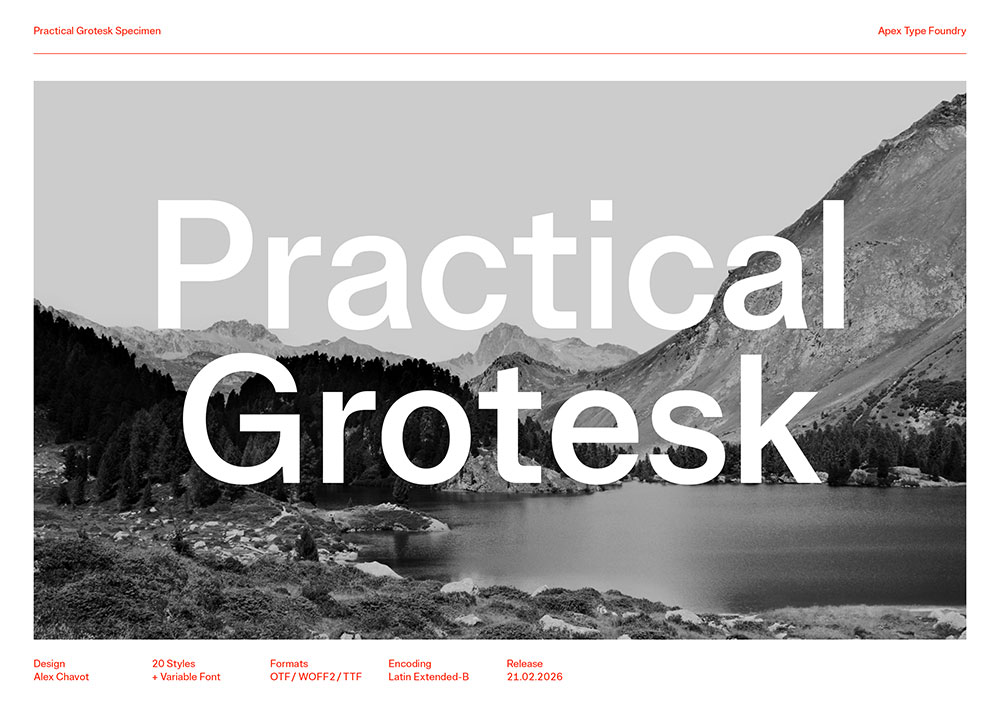
Investigating the rational simplicity of mid-twentieth century modernism, Practical Grotesk is Apex’s take on the neo-grotesque genre. Drawing influence from the superstars of the last century (Akzidenz Grotesk, Folio, Neue Haas Grotesk) as well as later, more “confidential” responses (Forma, Unica), Practical Grotesk is an exercise in style, a love letter and a tribute to the legacy of Swiss typography.
Initially developed as a single regular style to embody and carry the identity of Apex, Practical Grotesk gradually grew into a comprehensive family of ten weights—from Hairline to Black—with matching italics, offering graphic designers a solid and versatile sans-serif workhorse.
Ready to perform across a wide range of applications, from discreet footnotes to striking billboards, Practical Grotesk is a utilitarian yet spirited typeface. Not devoid of a certain warmth, it comes fully equipped with numerous key alternates, multiple figure sets, ligatures and case-sensitive forms, among other features, making it a reliable ally for demanding contemporary design contexts.
Global branding, fashion, architecture, packaging—Practical Grotesk is designed to adapt with precision and confidence. And, as a final touch, it is available as a two-axis variable font (weight and slant), giving designers full control over its design space for large-scale graphic applications.
Download PDF
You may also like
 View all