
The following OpenType features are included in this font:
ANTI-FREEZE
SETTLEMENT
Pay for the Printer
Philip Kindred Dick
In a war-ravaged future, humanity has come to depend on an alien species known as the Biltongs, possessed of the ability to replicate items identically—although the copies only last for a short time. When the Biltongs become decrepit, the humans are forced to rediscover the skill of building.
Bradley Robert Arthur Congdon makes the case that “Pay for the Printer” is a critique “of the culture of consumerism and mass production.” Congdon connects Dick’s story to a left wing analysis of the failings of capitalism, writing that, “it is not much of a stretch to see that a Marxian idea of alienation is at work, where mankind is so alienated from its labour that the possibility of survival is hamstrung.”
The earth is devastated after a conflict involving the explosion of H-bombs. There are very few remnants of civilization and the lands are devastated due to the fact it doesn’t rain anymore. Allen Fergesson is a member of the Pittsburgh colony, the story begins in his car where he’s with Charlotte, a member of a decaying colony where the Biltong is sick, and a mysterious man they picked up on the road. When they arrive at the colony everything is falling apart, they meet Ben trying to fuel his car at the gas station. They pick him up and then go to Charlotte’s apartment but there are cracks all over the walls and wobbly scaffolding surrounds the building. She tries to get into the building but a structure falls on her, nobody is competent and the workers are only voluntary civilians. After finding new clothes for Charlotte which have turned to ashes they arrive at the Biltong which is formed of a yellow protoplasm topped by pseudopodia. Inside there’s a core made of filaments. The alien seems tired and is surrounded by empty eggs, indeed the Biltongs have become sterile after they stay on Earth. Allen presents to the alien originals object that weren’t previously duplicated in hopes of bringing him life again, but it fails. The crowd surrounding them becomes agitated when they see Allen’s brand new car and a riot breaks out. Ben and Charlotte get away with the car. Allen ends up with the mysterious man who we discover is named Dawes, a survivor of the Chicago colony who felt apart due to the death of their Biltong. He shows to Allen a mug of wood he made along with a primitive knife and shares with him the importance of handcrafting instead of duplicating.
Informations
aalt
calt
case
ccmp
cpsp
dnom
frac
hist
kern
liga
lnum
locl
numr
onum
ordn
pnum
sinf
ss01
ss02
ss03
ss04
ss05
ss06
ss07
ss08
subs
sups
tnum
zero
- dark ss01Alternative a
- kraken ss02Alternative k
- yoyo ss03Alternative y
- M&M’s ss04Alternative ampersand
Glyphset
A
Uppercases
A
B
C
D
E
F
G
H
I
J
K
L
M
N
O
P
Q
R
S
T
U
V
W
X
Y
Z
Lowercases
a
b
c
d
e
f
g
h
i
j
k
l
m
n
o
p
q
r
s
t
u
v
w
x
y
z
Accented Uppercases
À
Á
Â
Ã
Ä
Ā
Ă
Å
Ǻ
Ą
Æ
Ǽ
Ć
Ĉ
Č
Ċ
Ç
Ď
Đ
È
É
Ê
Ẽ
Ě
Ë
Ē
Ĕ
Ė
Ę
Ĝ
Ǧ
Ḡ
Ğ
Ġ
Ģ
Ĥ
Ħ
Ì
Í
Î
Ĩ
Ï
Ī
Ĭ
İ
Į
IJ
Ĵ
Ķ
Ĺ
Ľ
Ļ
Ł
Ŀ
Ń
Ň
Ñ
Ņ
Ò
Ó
Ô
Õ
Ö
Ō
Ŏ
Ő
Ǫ
Ø
Ǿ
Œ
Ŕ
Ř
Ŗ
ẞ
Ś
Ŝ
Š
Ş
Ș
Ť
Ț
Ţ
Ŧ
Ù
Ú
Û
Ũ
Ü
Ū
Ŭ
Ů
Ű
Ų
Ẁ
Ẃ
Ŵ
Ẅ
Ỳ
Ý
Ŷ
Ỹ
Ÿ
Ȳ
Ź
Ž
Ż
Ə
Ɲ
Ŋ
Ð
Þ
DŽ
Dž
LJ
Lj
NJ
Nj
Accented Lowercases
à
á
â
ã
ä
ā
ă
å
ǻ
ą
æ
ǽ
ć
ĉ
č
ċ
ç
ď
đ
è
é
ê
ẽ
ě
ë
ē
ĕ
ė
ę
ĝ
ǧ
ḡ
ğ
ġ
ģ
ĥ
ħ
ì
í
î
ĩ
ï
ī
ĭ
i
į
ı
ij
ĵ
ȷ
ķ
ĺ
ľ
ļ
ł
ŀ
ń
ň
ñ
ʼn
ņ
ò
ó
ô
õ
ö
ō
ŏ
ő
ǫ
ø
ǿ
œ
ŕ
ř
ŗ
ś
ŝ
š
ş
ș
ß
ť
ț
ţ
ŧ
ù
ú
û
ũ
ü
ū
ŭ
ů
ű
ų
ẁ
ẃ
ŵ
ẅ
ỳ
ý
ŷ
ỹ
ÿ
ȳ
ź
ž
ż
ə
ɲ
ŋ
ð
þ
dž
lj
nj
Alternates
a
à
á
â
ã
ä
ā
ă
å
ǻ
ą
æ
ǽ
k
ķ
y
ỳ
ý
ŷ
ỹ
ÿ
ȳ
&
Ligatures
Th
ſ
fb
ffb
ff
fh
ffh
fi
ffi
fj
ffj
fk
ffk
fl
ffl
ft
fft
tt
Diacritics
̀
́
̋
̂
̌
̆
̊
̇
̈
̃
̄
·
·
̀
́
̋
̂
̌
̆
̊
̇
̈
̃
̄
̒
̦
̧
̨
Lining figures and currencies
#
0
1
2
3
4
5
6
7
8
9
€
$
₿
¢
£
₺
ƒ
¥
₸
฿
₴
₽
₹
₪
₩
₫
Old style figures and currencies
#
0
1
2
3
4
5
6
7
8
9
€
$
₿
¢
£
₺
ƒ
¥
₸
฿
₴
₽
₹
₪
₩
₫
Tabular figures and currencies
#
0
1
2
3
4
5
6
7
8
9
€
$
₿
¢
£
₺
ƒ
¥
₸
฿
₴
₽
₹
₪
₩
₫
Tabular old style figures and currencies
#
0
1
2
3
4
5
6
7
8
9
€
$
₿
¢
£
₺
ƒ
¥
₸
฿
₴
₽
₹
₪
₩
₫
Slashed Zeros
0
Mathematical symbols
+
−
±
×
÷
=
≠
~
≈
^
¬
⌀
¤
<
>
≤
≥
∞
◊
Δ
Ω
∂
∫
√
∑
∏
π
μ
°
ℓ
℮
〈
〉
【
】
「
」
《
》
〔
〕
〖
〗
『
』
Case sensitive mathematical punctuation
+
−
×
÷
=
≠
~
≈
¬
<
>
Superior figures
,
.
(
)
+
−
×
÷
=
0
1
2
3
4
5
6
7
8
9
Inferior figures
,
.
(
)
+
−
×
÷
=
0
1
2
3
4
5
6
7
8
9
Numerators
,
.
(
)
+
−
×
÷
=
0
1
2
3
4
5
6
7
8
9
Denominators
,
.
(
)
+
−
×
÷
=
0
1
2
3
4
5
6
7
8
9
Open circled figures
0
1
2
3
4
5
6
7
8
9
10
Close circled figures
0
1
2
3
4
5
6
7
8
9
10
Fractions
⁄
%
‰
¼
½
¾
⅛
⅜
⅝
⅞
Roman Figures
Ⅰ
Ⅱ
Ⅲ
Ⅳ
Ⅴ
Ⅵ
Ⅶ
Ⅷ
Ⅸ
Ⅼ
Ⅽ
Ⅾ
Ⅿ
Standard Punctuation
,
;
:
.
…
-
!
¡
?
¿
‽
⸮
@
‘
’
“
”
‚
„
'
"
‹
›
«
»
&
/
\
|
¦
_
–
—
•
·
(
)
[
]
{
}
*
⁂
†
‡
§
¶
Case sensitive punctuation
-
–
—
·
‹
›
«
»
(
)
[
]
{
}
¡
¿
@
Abbreviations
℃
℉
©
℗
®
™
℠
ª
º
№
Geometrical symbols
■
□
◆
◇
●
○
◧
◨
⬒
⬓
◩
⬔
⬕
◪
⬖
⬗
⬘
⬙
◐
◑
◓
◒
◀
▶
▲
▼
◁
▷
△
▽
◂
▸
▴
▾
◃
▹
▵
▿
⏏
⏪
⏩
⏫
⏬
⏮
⏭
⏯
⏸
⏹
⏺
Miscellaneous symbols
✴
✳
✺
☀
☼
☽
☾
⚡
☁
⚙
♀
♂
⚲
⚫
⚪
◉
◎
🔍
🔎
🔒
🔓
≡
❌
⌘
♥
♡
⚑
⚐
★
☆
❤
♠
♣
♦
✓
✗
☐
☑
☒
❏
❍
◌
Arrows
←
↑
→
↓
↖
↗
↘
↙
↔
↕
➤
➣
➢
↰
↱
↲
↳
⬑
⬏
⬐
⬎
⭰
⭲
🔀
🔁
🔂
⮀
⮂
⮁
⮃
⮌
⮎
⮏
⮍
🔃
🔄
⟳
⟲
←
↑
→
↓
Alternative arrows
←
↑
→
↓
Languages
Abenaki, Afaan Oromo, Afar, Afrikaans, Albanian, Alsatian, Amis, Anuta, Aragonese, Aranese, Aromanian, Arrernte, Arvanitic, Asturian, Atayal, Aymara, Azerbaijani, Bashkir, Basque, Belarusian, Bemba, Bikol, Bislama, Bosnian, Breton, Cape Verdean Creole, Catalan, Cebuano, Chamorro, Chavacano, Chichewa, Chickasaw, Cimbrian, Cofán, Cornish, Corsican, Creek, Crimean Tatar, Croatian, Czech, Danish, Dawan, Delaware, Dholuo, Drehu, Dutch, English, Esperanto, Estonian, Faroese, Fijian, Filipino, Finnish, Folkspraak, French, Frisian, Friulian, Gagauz, Galician, Ganda, Genoese, German, Gikuyu, Gooniyandi, Greenlandic, Guadeloupean Creole, Gwich'in, Haitian Creole, Hän, Hawaiian, Hiligaynon, Hopi, Hotcąk, Hungarian, Icelandic, Ido, Igbo, Ilocano, Indonesian, Interglossa, Interlingua, Irish, Istro-Romanian, Italian, Jamaican, Javanese, Jèrriais, Kaingang, Kala Lagaw Ya, Kapampangan, Kaqchikel, Karakalpak, Karelian, Kashubian, Kikongo, Kinyarwanda, Kiribati, Kirundi, Klingon, Kurdish, Ladin, Latin, Latino sine Flexione, Latvian, Lithuanian, Lojban, Lombard, Low Saxon, Luxembourgish, Maasai, Makhuwa, Malay, Maltese, Manx, Māori, Marquesan, Megleno-Romanian, Meriam Mir, Mirandese, Mohawk, Moldovan, Montagnais, Montenegrin, Murrinh-Patha, Nagamese Creole, Nahuatl, Ndebele, Neapolitan, Ngiyambaa, Niuean, Noongar, Norwegian, Novial, Occidental, Occitan, Old Icelandic, Old Norse, Onĕipŏt, Oshiwambo, Ossetian, Palauan, Papiamento, Piedmontese, Polish, Portuguese, Potawatomi, Q'eqchi', Quechua, Rarotongan, Romanian, Romansh, Rotokas, Sami, Samoan, Sango, Saramaccan, Sardinian, Scottish Gaelic, Serbian, Seri, Seychellois Creole, Shawnee, Shona, Sicilian, Silesian, Slovak, Slovenian, Slovio, Somali, Sorbian, Sotho, Spanish, Sranan, Sundanese, Swahili, Swazi, Swedish, Tagalog, Tahitian, Tetum, Tok Pisin, Tokelauan, Tongan, Tshiluba, Tsonga, Tswana, Tumbuka, Turkish, Turkmen, Tuvaluan, Tzotzil, Uzbek, Venetian, Vepsian, Volapük, Võro, Wallisian, Walloon, Waray-Waray, Warlpiri, Wayuu, Welsh, Wik-Mungkan, Wiradjuri, Wolof, Xavante, Xhosa, Yapese, Yindjibarndi, Zapotec, Zarma, Zazaki, Zulu, Zuni
About
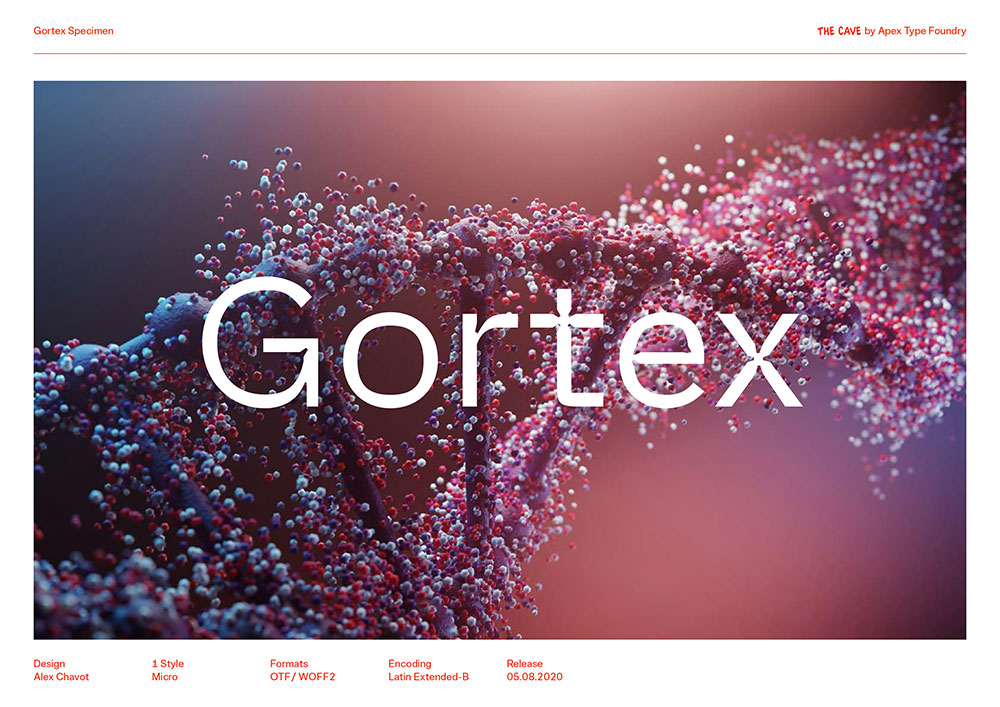
Grotex was initially a small family inspired by 20th-century European sans-serifs. Moving beyond a simple historical grotesk revival, it was designed as a geometric sans with humanistic undertones—versatile enough for both display and running text. During the development of the family, a monospace and a weird “micro” version (for very small sizes) came to life as special companions to the standard styles. These deliberate distortions turned the Micro style into Grotex’s crooked twin brother.
A few years later, the name “Grotex” was unfortunately stolen. This new version—Gortex Micro—became the family’s only survivor. Specifically optimized for extreme small-size usage, Gortex has been fully redrawn with exaggerated ink traps, shortened descenders, splayed squarish counters, and loose spacing.
While these “flaws” vanish into a grey texture at 6pt, they nevertheless reveal a striking, aggressive character when scaled up. In the spirit of classics like Matthew Carter’s Bell Centennial, Gortex Micro’s design ensures perfect legibility at any size while remaining utterly surprising as a titling face in larger sizes. Because, yeah, we know how it’s going to end anyway…
Download PDF
You may also like

 View all